About Sericocarpus rigidus Lindl.
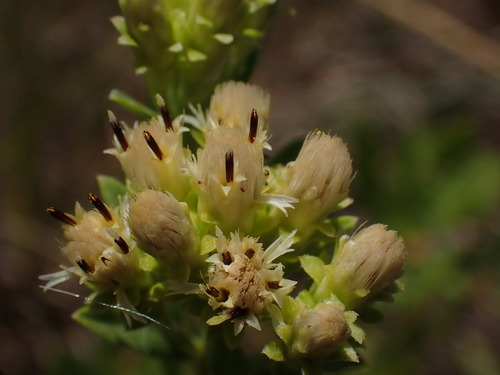
Sericocarpus rigidus, commonly known as Columbian whitetop aster, is a species of flowering plant in the Asteraceae family. It is native to the Pacific Northwest region of North America, with a range extending from southern Vancouver Island in British Columbia, south along the coast through Washington to Oregon. This rhizomatous perennial herb reaches up to around 37 centimeters in height. The leaves growing along its stem are somewhat oval-shaped, and can grow up to 6 centimeters long. Its inflorescence is made up of clusters of flower heads, each of which grows up to around one centimeter long. Each flower head contains white or off-white disc florets, and usually holds a few white ray florets as well. This species grows in grassland habitat that is typically dominated by Idaho fescue, Festuca idahoensis. In the northern portion of its range, it grows in gravelly soils formed by past glacial activity, while it grows in clay soils further south within its range. The soils it inhabits stay moist through most of the year, but dry out during the summer. Plant species that commonly grow alongside it include Symphoricarpos albus (snowberry), Amelanchier alnifolia (serviceberry), Eriophyllum lanatum (Oregon sunshine), and Viola adunca (early blue violet). A large portion of this plant's habitat is also populated by introduced species, including Cytisus scoparius (Scot's broom) and Aira praecox (yellow hairgrass). Invasion of its native habitat by these introduced species is a major threat to Sericocarpus rigidus. Additional threats to the species include habitat loss from human development, damage from off-road vehicles, impacts from military activity, and fire suppression.