About Sequoiadendron giganteum (Lindl.) J.T.Buchholz
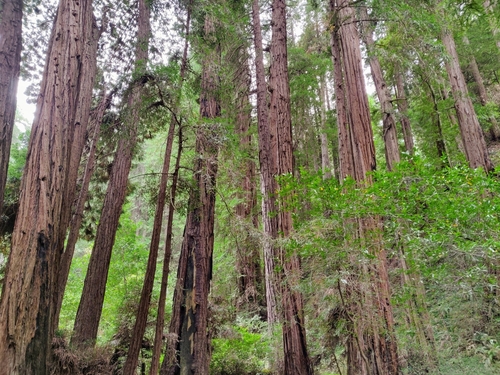
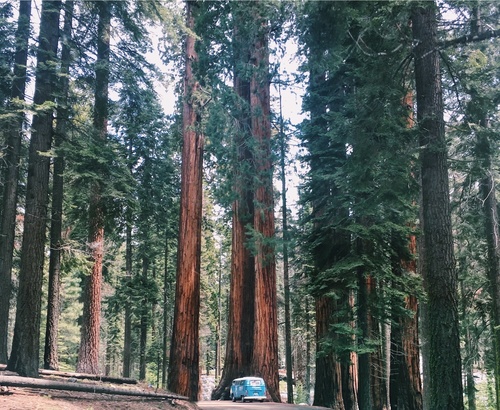
Giant sequoia (Sequoiadendron giganteum (Lindl.) J.T.Buchholz) specimens are the most massive individual trees in the world. They grow to an average height of 50–85 m (164–279 ft), with trunk diameters ranging from 6–8 m (20–26 ft). The tallest reliably measured record giant sequoia reaches 94.8 m (311 ft). A claim of a 17 m (56 ft) trunk diameter comes from research figures taken out of context. The specimen confirmed to have the greatest diameter at breast height is the General Grant Tree, at 8.8 m (28.9 ft). Between 2014 and 2016, it was claimed that coast redwood specimens were found with greater trunk diameters than all known giant sequoias, but this claim has not been independently verified or affirmed in any academic literature. Compared to giant sequoias, coast redwood trunks taper at lower heights; giant sequoia trunks are more columnar and retain larger diameters to greater heights. The oldest known giant sequoia has been dated to 3,200–3,266 years old via dendrochronology. This tree has the fourth-longest verified lifespan of any tree, behind individual Great Basin bristlecone pines and alerces. Giant sequoia bark is fibrous, furrowed, and can be 90 cm (3 ft) thick at the base of the columnar trunk. The sap contains tannic acid, which provides significant protection from fire damage. Giant sequoia leaves are evergreen, awl-shaped, 3–6 mm (1⁄8–1⁄4 in) long, and arranged spirally on shoots. Its wood is famously resistant to decay. A "nearly complete" S. giganteum log discovered 800 m (0.50 mi) south of Nelder Grove has given a radiocarbon-14 date of 10,000 years. Because of the species' longevity, fast growth, and large size, it has high carbon storage potential for carbon sequestration. Giant sequoia regenerates by seed. Its seed cones are 4–7 cm (1+1⁄2–3 in) long and mature in 18–20 months, though they typically stay green and closed for up to 20 years. Each cone has 30–50 spirally arranged scales, with several seeds per scale, for an average of 230 seeds per cone. Seeds are dark brown, 4–5 mm (0.16–0.20 in) long, 1 mm (0.04 in) broad, with a 1-millimeter (0.04 in) wide yellow-brown wing along each side. Some seeds are shed when cone scales shrink during hot late summer weather, but most seeds are released by insect damage or when heat from fire dries the cones. Trees do not start bearing cones until they are 12 years old. Young trees up to around 20 years old may produce sprouts from their stumps after injury, but unlike coast redwoods, mature giant sequoias do not grow new shoots from stumps. Giant sequoias of all ages can sprout from their boles after branches are lost to fire or breakage. A large giant sequoia can have as many as 11,000 cones, with the highest cone production in the upper portion of the canopy. A mature giant sequoia disperses an estimated 300,000–400,000 seeds each year. Winged seeds can travel as far as 180 m (590 ft) from the parent tree. Lower branches die easily from shading, but trees younger than 100 years retain most of their dead branches. Trunks of mature trees growing in groves are generally free of branches up to a height of 20–50 m (70–160 ft), while solitary trees retain their lower branches. The natural distribution of giant sequoias is restricted to a limited area of the western Sierra Nevada, California. As a paleoendemic species, it occurs in scattered groves, with a total of 81 groves that cover a total area of only 144.16 km2 (35,620 acres). Nowhere does giant sequoia grow in pure stands, though a few small areas have stands that approach pure conditions. The northern two-thirds of its range, from the American River in Placer County southward to the Kings River, contains only eight disjunct groves. The remaining southern groves are concentrated between the Kings River and the Deer Creek Grove in southern Tulare County. Groves range in size from 12.4 km2 (3,100 acres) with 20,000 mature trees, to small groves with only six living trees. Many giant sequoia groves are protected within Sequoia and Kings Canyon National Parks and Giant Sequoia National Monument. Giant sequoia typically grows in a humid climate with dry summers and snowy winters. Most giant sequoia groves grow on granitic-based residual and alluvial soils. The elevation of giant sequoia groves generally ranges from 1,400–2,000 m (4,600–6,600 ft) in the northern part of the range, and 1,700–2,150 metres (5,580–7,050 ft) in the south. Giant sequoias generally grow on the south-facing sides of northern mountains, and on the northern faces of more southerly slopes. High levels of reproduction are not needed to maintain current population levels. However, few groves have enough young trees to maintain the current density of mature giant sequoias into the future. The majority of giant sequoia groves have undergone a gradual decline in density since European settlement. While giant sequoia's current distribution is limited to a small area of California, it was once much more widely distributed in prehistoric times. It was a reasonably common species in North American and Eurasian coniferous forests until its range was greatly reduced by the last ice age. Older fossil specimens reliably identified as giant sequoia have been found in Cretaceous era sediments at multiple sites in North America and Europe, and even as far away as New Zealand and Australia. Giant sequoias are adapted to forest fires in many ways. Their bark is unusually fire resistant, and their cones normally open immediately after a fire. Giant sequoias are a pioneer species, and struggle to reproduce in their original habitat (and very rarely reproduce in cultivation). This is because giant sequoia seeds can only grow successfully in full sun and mineral-rich soils free from competing vegetation. While seeds can germinate in moist needle humus in spring, seedlings die as the duff dries in summer. For this reason, they require periodic wildfire to clear competing vegetation and soil humus before successful regeneration can happen. Without fire, shade-loving species crowd out young giant sequoia seedlings, and giant sequoia seeds do not germinate. Giant sequoias require large amounts of water and are often concentrated near streams, with growth dependent on soil moisture. Squirrels, chipmunks, finches and sparrows eat newly sprouted seedlings, stopping their growth. Fires also carry hot air high into the canopy via convection, which dries and opens the cones. The release of large quantities of seeds coincides with the optimal postfire seedbed conditions. Loose ground ash may also act as a cover to protect fallen seeds from damage by ultraviolet radiation. Due to fire suppression efforts and livestock grazing during the early and mid-20th century, low-intensity natural fires no longer occur in many groves, and still do not occur in some groves today. Fire suppression leads to a buildup of ground fuel and dense growth of fire-sensitive white fir, which increases the risk of more intense fires that can use firs as ladders to threaten the crowns of mature giant sequoias. Natural fires may also help keep carpenter ants in check. In 1970, the National Park Service began using controlled burns in giant sequoia groves to correct these problems. Current policies also allow natural fires to burn. One of these unplanned burns severely damaged the second-largest tree in the world, the Washington tree, in September 2003, 45 days after the fire started. This damage left the tree unable to withstand the January 2005 snowstorm, leading to the collapse of over half its trunk. In addition to fire, two animal species assist giant sequoia with seed release. The more significant of the two is a longhorn beetle (Phymatodes nitidus) that lays eggs on the cones, and its larvae bore holes into the cones. This reduces the vascular water supply to the cone scales, allowing the cones to dry and open for seeds to fall. Cones damaged by beetles during the summer open slowly over the next several months. Some research shows many cones, especially those higher in the crowns, may need partial drying from beetle damage before fire can fully open them. The second animal agent is the Douglas squirrel (Tamiasciurus douglasi) that gnaws on the fleshy green scales of younger cones. Squirrels are active year-round, and some seeds are dislodged and dropped as the cone is eaten. More than 30 identified species of bird have been observed living in giant sequoia groves. Wood from mature giant sequoias is highly resistant to decay, but it is fibrous and brittle, so it is generally unsuitable for construction. From the 1880s through the 1920s, logging took place in many groves despite low commercial returns. The Hume-Bennett Lumber Company was the last company to harvest giant sequoia, and went out of business in 1924. Because of their weight and brittleness, trees often shattered when they hit the ground, wasting much of the wood. Loggers tried to cushion the impact by digging trenches and filling them with branches. Even so, it is estimated that as little as 50% of the timber made it from the groves to the mill. The wood was mainly used for shingles, fence posts, and even matchsticks. Images of broken, abandoned giant trees in formerly undisturbed groves, and the idea of these giants being put to such modest use, sparked public outcry that led to most groves being preserved as protected land. The public can visit an example of 1880s clear-cutting at Big Stump Grove near General Grant Grove. As recently as the 1980s, some immature trees were logged in Sequoia National Forest, and publicity of this logging helped lead to the creation of Giant Sequoia National Monument. Wood from immature trees is less brittle, and recent tests on young plantation-grown trees show its quality is similar to coast redwood wood. This has led to interest in cultivating giant sequoia as a very high-yielding timber crop, both in California and parts of western Europe, where it may grow more efficiently than coast redwood. In the northwest United States, some entrepreneurs have also started growing giant sequoias for Christmas trees. Besides these tree farming attempts, the main economic uses for giant sequoia today are tourism and horticulture.