About Senna wislizeni (A.Gray) H.S.Irwin & Barneby
Senna wislizeni (A.Gray) H.S.Irwin & Barneby is commonly known as Wislizenus' senna or shrubby senna. It was previously classified under the broadly defined "wastebin taxon" Cassia sensu lato, and some older sources referred to it simply as cassia, a term that now generally applies to larger members of the Cassiinae subfamily. Some taxonomic treatments place this species in the genus Senna, while others separate it into the genus Palmerocassia alongside Senna unijuga.
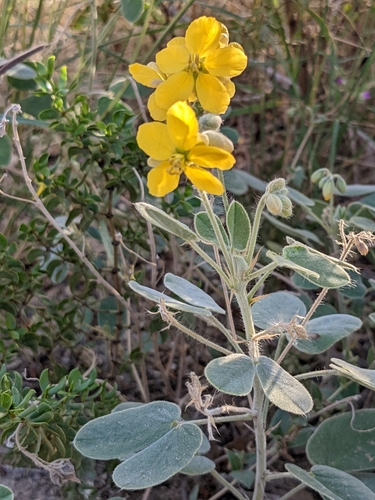
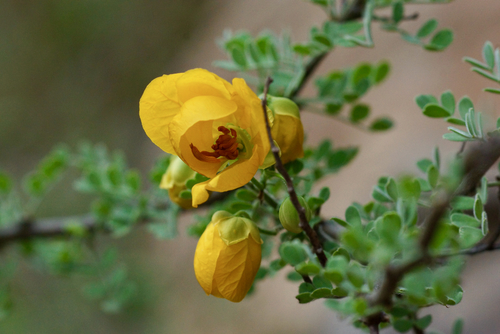
This species is a perennial deciduous shrub native to Chihuahua and Hidalgo, Mexico, and to Texas, New Mexico, and Arizona in the United States. It grows as a desert plant, with high tolerance for heat and drought. Mature individuals can reach 10 feet (3.0 meters) in height, with an equal 10-foot spread. It produces compound foliage. In summer, particularly late summer, it bears yellow flowers that develop into long, flat, dark brown seed pods. Its flowers are visited by carpenter bees and bumblebees, and sulphur butterflies use this plant as a food source for their larvae.
The species is named for F. A. Wislizenus, a botanist who studied Mexican flora in the mid-19th century. Some sources incorrectly spell the specific epithet as "wislizenii"; the correct spelling uses only one final "i", in accordance with Article 60C.2 of the International Code of Nomenclature for algae, fungi, and plants. Three named varieties are recognized: Senna wislizeni var. painteri (Britton & Rose) H.S.Irwin & Barneby, with synonyms Cassia wislizenii A. Gray var. painteri (Britton & Rose) H.S.Irwin & Barneby and Palmerocassia painteri Britton & Rose; Senna wislizeni var. pringlei (Rose) H.S.Irwin & Barneby, with synonyms Cassia morelensis Greenm., Cassia pringlei Rose, and Palmerocassia pringlei (Rose) Britton & Rose; and Senna wislizeni var. villosa (Britton & Rose) H.S.Irwin & Barneby, with synonyms Cassia wislizenii A. Gray var. villosa (Britton & Rose) H.S.Irwin & Barneby and Palmerocassia villosa Britton & Rose.