About Senna venusta (F.Muell.) Randell
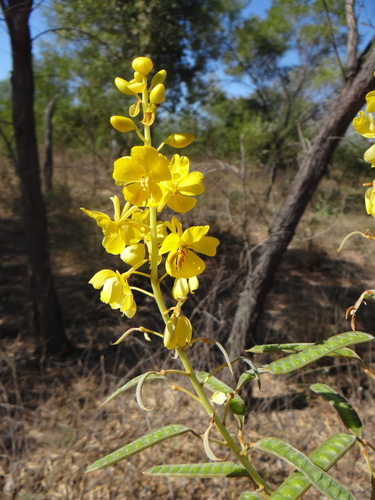
Senna venusta is an erect shrub that typically grows up to 2 m (6 ft 7 in) tall. Its vegetative parts have soft hairs, and the plant is otherwise mostly glabrous. The leaves are pinnate, 100–350 mm (3.9–13.8 in) long, growing on a 10–30 mm (0.39–1.18 in) petiole. Each leaf has 6 to 15 pairs of oblong to egg-shaped leaflets that are 30–80 mm (1.2–3.1 in) long and 10–35 mm (0.39–1.38 in) wide, with leaflets spaced 15–30 mm (0.59–1.18 in) apart. The yellow flowers are densely arranged into cone-like heads holding 15 to 40 flowers. The heads grow in upper leaf axils and at the ends of branchlets, on a 40–80 mm (1.6–3.1 in) long peduncle, with each flower borne on a 12–15 mm (0.47–0.59 in) long pedicel. The petals are about 15 mm (0.59 in) long. Each flower has seven fertile stamens, three staminodes, and anthers of two different lengths. Flowering occurs from February to September, and the fruit is a flat pod 40–80 mm (1.6–3.1 in) long and 9–14 mm (0.35–0.55 in) wide. This species grows in sand over gravel, or in lateritic soils, and often occurs alongside Triodia species. It is widespread in arid areas of northern Western Australia and the Northern Territory, with a few collections documented from north-western Queensland.