About Senna surattensis (Burm.f.) H.S.Irwin & Barneby
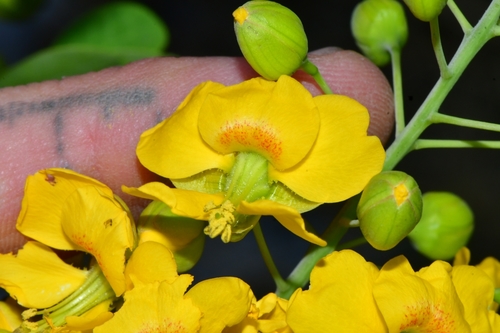
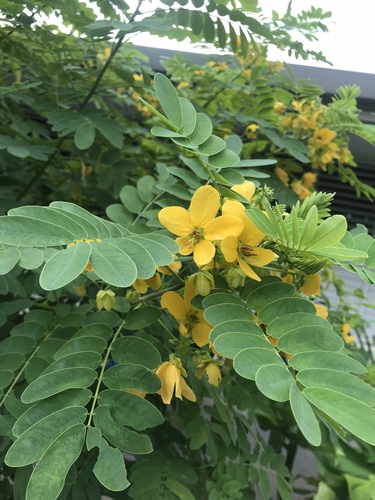
Senna surattensis (Burm.f.) H.S.Irwin & Barneby grows as a shrub or small tree reaching up to 11 meters in height. Its stems are hairy, sometimes sparsely hairy or nearly hairless. It has alternate compound leaves, with linear stipules that are 2–3 mm long. The petiole is 2–6.5 cm long, channeled, and thinly hairy. Stalked glands occur on leaflet pairs, with 2–5 glands per leaf, and one gland solitary at the lowest leaflet pair. It has 8–20 opposite leaflets arranged in paripinnate pinnately compound leaves, with the largest leaflets located on the upper part of the leaf. Petiolules are 1–2 mm long. Leaflet blades are ovate, oblong to obovate, measuring 2.5–10 cm long and 0.8–3 cm wide, with a rounded or cuneate, sometimes lopsided, base. Leaf margins are entire, and the apex is rounded or emarginate. Each leaflet has 6–12 pairs of lateral veins. Leaflets and the leaf rachis are lightly hairy to hairless. Older leaves may drop during drought or winter. This species has often been confused with Senna sulfurea and Senna siamea, but it differs from those species in having many more smaller leaflets, smaller brachystylous flowers, and shorter, short-stipitate pods. The native origin of this species remains unclear. Historically, it was thought to be native to coastal northern Australia and Malesia, but Symon (1966) argued it was likely introduced to those areas. Liogier and Martorell (2000), however, consider the species native to Australia. The Agricultural Research Service (2014) lists the species as native to Laos, Myanmar, the Philippines, Thailand, and Vietnam. The species is found across several tropical and subtropical regions including Southeast Asia, Africa, and the West Indies, where it has escaped cultivation and become naturalized. It is commonly planted in Sri Lanka but has not become naturalized there. In other regions, it grows at lower altitudes along roadsides, in pastures, and on wastelands. In Southeast Asia, it thrives in teak forests and boggy soils, while in Hawaii it grows in volcanic zones and coastal forests. This plant has moderate drought tolerance, especially once established, and grows in well-drained, moist, loamy and marshy soils. It is planted along roadsides, in parks, and in small gardens as a shade tree and hedge plant. It can be easily toppled by heavy winds, so it requires many years to become fully established in the ground. It is hardy to USDA zone 9 and prefers monthly fertilization. It can tolerate sulphur dioxide pollution, which makes it a commonly planted ornamental in populated regions such as the Philippines and Hong Kong. It is propagated by seed. It has been recorded in cultivation on St. Vincent and the Windward Islands before 1826. It may have been included (under the name Cassia glauca Lam.) in Grisebach's flora of the British West Indies, where it was reported from Jamaica, Saint Kitts, Antigua and St. Vincent, and also incorrectly noted as native to Guadeloupe and the East Indies. It was likely cultivated in Trinidad by 1870, and was introduced as an ornamental to Puerto Rico shortly after 1826. It became naturalized in Hawaii by 1871, and has been present in Sri Lanka since 1824. In Southeast Asia, the young juvenile leaves are cooked and eaten as a vegetable. In the Philippines, it is used in teak plantations as a shade tree and hedge plant. Its roots have been used to treat gonorrhoea, its leaves to treat dysentery, and its flowers as a laxative.