About Senna marilandica (L.) Link
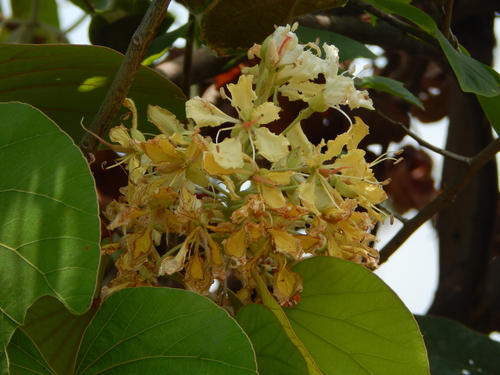
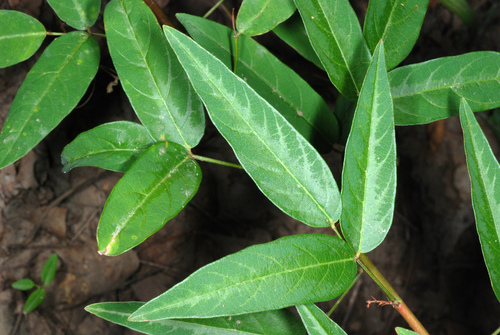
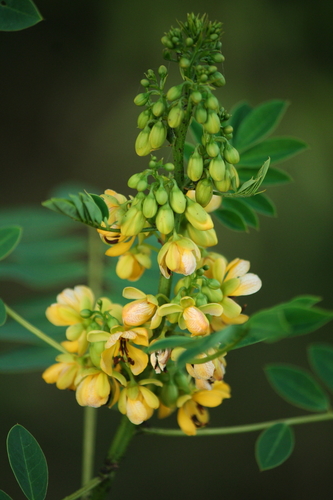
Senna marilandica (L.) Link produces green, round, unbranched stems that grow from a shallow, fibrous root system, and reach an average height of around 2 meters (6 feet). Its leaves are alternate, pinnate compound leaves, with each leaf bearing four to eight pairs of opposite leaflets. Individual leaflets can grow up to 6 cm (2.5 in) long and 2 cm (0.75 in) wide, and range in shape from ovate to elliptic. This species produces inflorescences that are racemes holding six to nine yellow flowers; these racemes grow both from leaf axils (axillary inflorescences) and at the tips of stems (terminal inflorescences). Axillary inflorescences can grow up to 15 cm (6 in) long, while terminal inflorescences measure between 15 and 30 cm (6 to 12 in) long. Each flower is roughly 2 cm (0.75 in) across, with five yellow petals and five greenish-yellow sepals. Its stamens have prominent brownish anthers, and the flowers themselves lack nectaries. After fertilization, the plant develops drooping, pea-like seed pods that can grow up to 8 cm (3 in) long.
In the United States, S. marilandica is native to a range extending west to Nebraska, south to Florida and Texas, north to Wisconsin, and east to New York. It is classified as a species of special concern within Wisconsin. This plant grows in woodland edges, open fields, thickets, and moist habitats including riverbanks and moist prairies.
Flowering occurs from early July to late August, and seed pods develop from early August to late September. Pollinator visitors to the flowers include bumblebees, butterflies, and solitary bees. While the flowers do not produce nectar, extrafloral nectaries grow at the base of upper stem leaves and within the inflorescence; ants, parasitic wasps, and lady beetles feed on the nectar from these extrafloral nectaries. Unlike many other species in the pea family, S. marilandica is not nodulated by nitrogen-fixing bacteria. It also acts as a larval host plant for four butterfly species: the cloudless sulphur (Phoebis sennae), orange-barred sulphur (Phoebis philea), sleepy orange (Eurema nicippe), and little sulphur (Eurema lisa).