About Senna bicapsularis (L.) Roxb.
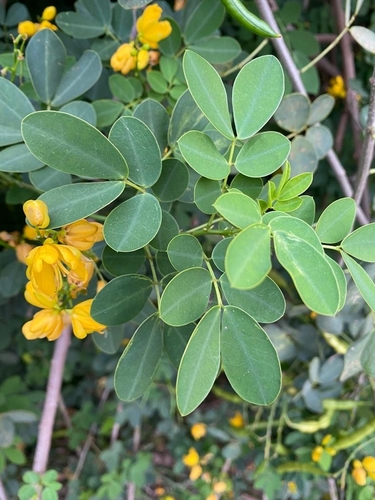
Senna bicapsularis (L.) Roxb. is a semi-evergreen shrub that grows from 2 to 12 metres tall, reaching up to 3.5 m in typical growth, with a low spreading crown. It branches from near the base and reproduces by seed. Its leaves are pinnate, 2.5–9 cm long, with 6 to 8 leaflets; each individual leaflet measures 1.6–4.5 cm long and 1.1–2.3 cm wide. Bright yellow flowers are borne in small clusters on short racemes, with each flower 12–16 mm long. This species blooms from autumn to winter, and its flowers attract bees and butterflies. Senna bicapsularis can be distinguished from the related species Senna pendula by several features: it has 3 pairs of leaflets per leaf and elongated flower stalks (pedicels), while S. pendula has 4–7 pairs of leaflets per leaf, a gland between each pair of leaflets, and shorter flower stalks. Senna bicapsularis flowers from late fall to winter, depending on local climate, whereas S. pendula can begin flowering as early as late summer. S. pendula grows easily from seed, while S. bicapsularis has a tough seed coat that requires mechanical scarification to successfully sprout. The Nahuas of San Luis Potosi use this plant in traditional healing practices for enchantment: the healer cleanses the patient by rubbing seven of the plant's leaves over the patient's entire body, while praying and perfuming the patient with incense made from charcoal, rosemary, and copal, then finishing the cleansing with an egg to remove harmful "bad air" that has affected the patient. Edible leaves are used to treat erysipelas in Morelos, and are used as an antiseptic in Oaxaca. Sap from mashed leaves, mixed with salt, can be used externally to heal rashes, sores, bites, stings, eczema, scabies, ringworm, and thrush. In the 20th century, botanist Maximino Martínez documented additional uses for the plant: it acts as a cathartic, and can counteract the effects of arthropod stings. The flavour of its seedpods resembles tamarind, and its leaves can be cooked as a vegetable, mixed with other leafy greens, beans, or peas.