About Senna auriculata (L.) Roxb.
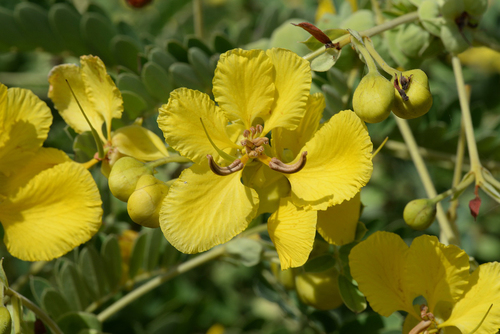
Senna auriculata (L.) Roxb., commonly called avaram senna, is a much-branched shrub. It has smooth cinnamon brown bark and closely pubescent (fine-haired) branchlets. Its leaves are alternate, stipulate, and paripinnate compound; they are very numerous and closely placed. The leaf rachis is 8.8–12.5 cm long, narrowly furrowed, slender, and pubescent, with an erect linear gland between each pair of leaflets. There are 16–24 leaflets per leaf, each very shortly stalked, 2–2.5 cm long and 1–1.3 cm broad. Leaflets are slightly overlapping, oval-oblong, obtuse at both ends, mucronate (tipped with a small point), glabrous or minutely downy, dull green, and paler on the underside. The stipules are very large, reniform-rotund (kidney-rounded), produced at the base on the side of the next petiole into a thread-like point, and persistent. Its flowers are irregular, monoicous, bright yellow, and large, reaching nearly 5 cm across. Flower pedicels are glabrous and 2.5 cm long. Racemes are few-flowered, short, erect, and crowded in the axils of upper leaves to form a large terminal inflorescence, with sterile stamens. The ovary is superior and unilocular, with marginal ovules. The fruit is a short legume, 7.5–11 cm long and 1.5 cm broad. It is oblong, obtuse, tipped with the base of the long style, flat, thin, papery, undulately crimpled, pilose (fine-haired), and pale brown. Each fruit holds 12–20 seeds, each contained in its own separate cavity. This plant has been reported to treat hyperglycemia and associated hyperlipidemia. It is recorded to contain the cardiac glycoside sennapicrin and sap; leaves and bark yield anthraquinones, while the bark additionally contains tannins. The root, prepared as a decoction, is used to treat fevers, diabetes, urinary system diseases, and constipation. The leaves have laxative properties. Tea made from dried flowers and flower buds is consumed by people with diabetes as a replacement for regular tea, and it is also believed to improve complexion. Powdered seeds are used to manage diabetes, and are applied to the eye to treat chronic purulent conjunctivitis. In Africa, the bark and seeds are reported to help treat rheumatism, eye diseases, gonorrhea, diabetes, and gout. This plant has antibacterial properties.