About Senecio triangularis Hook.
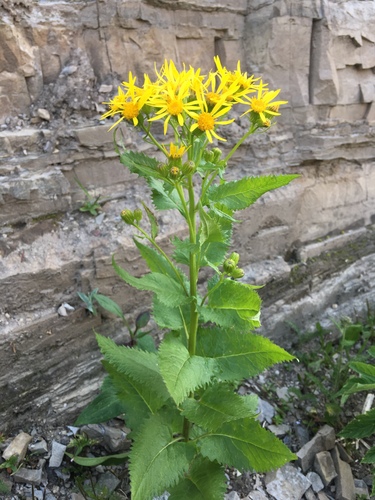
Senecio triangularis Hook. is similar in overall form to Senecio serra: both reach 4 feet tall, have narrow, serrated leaves, and are topped with many small yellow flower heads that resemble sunflowers, though Senecio triangularis is a more common species. Senecio triangularis grows single erect stems that reach 10 to 120 cm (4 to 47 in) tall. Leaves are evenly distributed along these stems; they can grow up to 20 cm (8 in) long and are triangular with tapered ends, which gives the species its name. Its green involucral bracts have black tips with hairy tufts. Yellow flower heads, which are present from June to September, can reach up to 4 cm (1+1⁄2 in) wide, and typically have around 8 ray florets surrounding a central disk. Some populations of this species are diploid (carrying two sets of chromosomes), a trait that can be used to identify hybrids and classify related groupings. Documented chromosome counts for this species are 2n = 40 and 2n = 80. It is native to temperate North America, in the Nearctic realm. Its native range covers Subarctic America including the Northwest Territories, Yukon Territory, and Alaska; Western Canada including Alberta and British Columbia; the Northwestern United States including Colorado, Idaho, Montana, Oregon, Washington, and Wyoming; and the Southwestern United States including Arizona, California, Nevada, Utah, and New Mexico. It grows in open woodlands, primarily coniferous forests, and on rocky stream banks. It can be found growing at altitudes between 100 and 3,500 m (330 and 11,480 ft). According to reports, this species is poisonous to animals.