About Senecio tamoides DC.
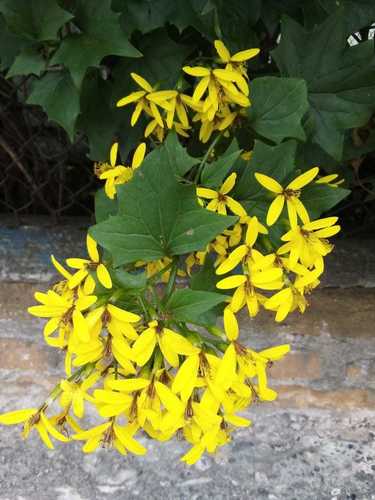
Senecio tamoides DC. is a fast-growing, mostly evergreen perennial climbing plant with semi-succulent stems and leaves. It can creep along the ground, or twine several meters up trees to reach the sunlit canopy where it produces flowers. It typically grows 2 to 4 meters (6.6 to 13 feet) tall, and can reach up to 10 meters (33 feet) tall in favorable conditions.
This species is native to southern Africa. Its native range extends from coastal Eastern Cape, South Africa to eastern Zimbabwe; it also grows in forested areas of KwaZulu-Natal, along the escarpment, and in bushveld savanna. It occurs at altitudes between 300 meters (980 feet) and 1,900 meters (6,200 feet), growing along evergreen forest margins and in moist gullies. It has been introduced to Southeast Brazil, Colombia, Eritrea, Ethiopia, Guatemala, Mauritius, Queensland, and Réunion.
In cultivation, it is a fairly drought-tolerant fast-growing garden plant that grows best in well-drained soil, grown against a wall or fence. It may need regular plant feeding to support robust growth and abundant flowering. It requires moderate watering until established, and grows well in locations with full sun to part shade. Its long stems need climbing support, such as a trellis or pergola; it can also be left to creep naturally through other shrubs, or planted beside a tree to climb on its own. For flowers to develop, the growing tips of the plant need full sunshine, while the base can tolerate full shade. While naturally evergreen, it may become semi-deciduous in regions with frosty winters: it dies back above ground, then regrows again in spring. Occasional pruning can be done to control its spread in the garden. It can be propagated from seed sown in spring, or from stem cuttings taken in summer.
In Sweden, this plant is called Sommarmurgröna, meaning 'summer ivy'. This common name is also used interchangeably for Delairea odorata, because the plant grows during summer and dies back to the ground during cold Swedish winters. Traditionally, it has been used medicinally to treat flatulence and anthrax in cattle. Common pests that affect it include aphids, red spider mites, caterpillars, and whiteflies; common diseases affecting it include rust.