About Senecio squalidus L.
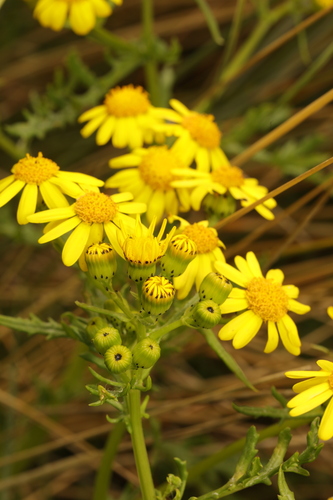
Like all members of the Asteraceae family, Senecio squalidus (common name Oxford ragwort) has a composite flower head called a capitulum. What appear to be single flowers are actually clusters of florets — each petal (or ligule) is an individual floret that has its own stamen, and can produce the achene, the parachute-like specialized seed characteristic of the Asteraceae family. Oxford ragwort can be a short-lived perennial, biennial, or winter annual. It grows in a branched, straggling form, reaching between 0.5m (1.5 feet) and 1m (3.3 feet) tall depending on growth conditions. It prefers dry, disturbed areas including cultivated ground, waste ground, walls, and railway banks. It flowers from March to December and reproduces by seed. Its leaves are alternate, glossy, nearly hairless, and variable in shape, ranging from deeply pinnately lobed to undivided; only the lower leaves have stalks. Its stems and leaves resemble those of common groundsel (Senecio vulgaris), except the lobes are more widely spaced. Its capitula are larger than those of Senecio jacobaea, and it has a more spreading growth habit. It bears loose clusters of yellow capitula, each with 10 to 14 petals, and is pollinated by insects. The ray corollas measure 8-15mm (0.3-0.6 inches) long and 2-4mm (0.08-0.16 inches) wide. Oxford ragwort is self-incompatible, meaning it requires pollen from other plants with different self-incompatibility alleles to reproduce. Its flower stigma has characteristics of both "dry" and "wet" stigma types. Fruiting heads are often nodding. Each pollinated floret matures into a bell to cylindrical, indehiscent achene. This shallowly ribbed fruit is light brown, and measures 1.5-3mm (0.06-0.12 inches) long. A single plant can produce roughly 10,000 fruits in a year. As a diploid member of the genus Senecio, S. squalidus is part of a species group that also includes S. flavus, S. gallicus, S. glaucus, and S. vernalis. These species are geographically widespread, and are studied for genetic differences related to environment and plant evolution. In its native range, S. squalidus grows on scree in mountainous areas. Its common name "Oxford ragwort" comes from its ability to grow in similar scree-like habitats around the world. There is conflicting information about its native range from USDA resources: the USDA Natural Resources Conservation Service lists it as native to New Brunswick and Nova Scotia, Canada, while the USDA Germplasm Resources Information Network lists it as native to Austria, Czechia, Slovakia, Germany, Switzerland, Albania, Bulgaria, Greece, Crete, Italy, Sardinia, Sicily, Romania, Bosnia and Herzegovina, Croatia, Montenegro, North Macedonia, Serbia, and Slovenia. Its current distribution includes: Northern Africa: Morocco; North America: New Brunswick, Nova Scotia, British Columbia, California; Europe: Northern Europe: Denmark, Germany, Republic of Ireland, Netherlands, Norway, Sweden, United Kingdom; Central Europe: Austria, Czechia, Hungary, Slovakia, Switzerland; Eastern Europe: Poland; Southeastern Europe: Albania, Bosnia and Herzegovina, Bulgaria; Southwestern Europe: France, Spain; Southern Europe: Croatia, Crete, Greece, Italy, North Macedonia, Romania, Sardinia, Serbia, Sicily, Slovenia.