About Senecio ilicifolius Thunb.
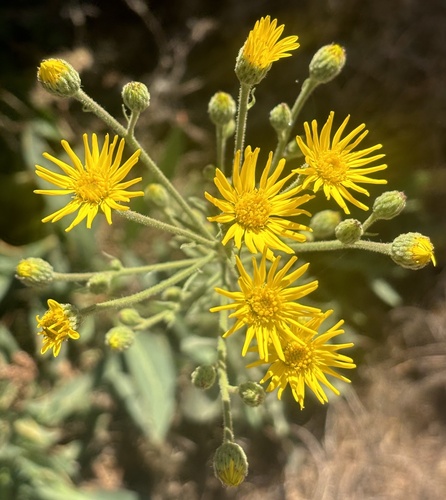
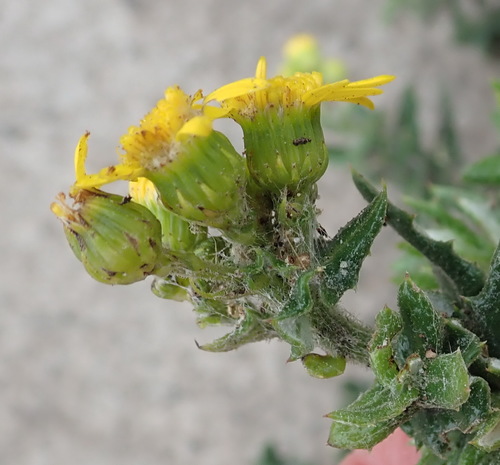
Senecio ilicifolius Thunb. is a species of flowering plant in the Asteraceae family, endemic to South Africa, where it grows in the Eastern and Western Cape provinces. This plant grows up to 1 metre (3 ft 3 in) tall, and can be easily recognized by its rigid, holly-like leaves. The leaves are clasping, adnate, and somewhat decurrent at the base, with acute tips, sharp coarse teeth, and revolute margins. The upper leaf surface is glabrous with scabrous dots, while the lower surface is covered in a whitish felt. Species in the genus Senecio are rich sources of alkaloids, and Meyler's Side Effects of Herbal Medicines notes that Senecio ilicifolius produces the alkaloids pterophine and senecionine. Senecionine, with the chemical formula C18H25O5N, is toxic to both livestock and humans. It causes liver cirrhosis, has a melting point of 232°, and is only slightly soluble in water. This toxin is not destroyed when baking bread made from flour that contains contaminated wheat. This text calls attention to a human disease in South Africa caused by Senecio poisoning, which is of special interest because it matches the conditions caused by the same poisoning in domesticated animals. In 1918, cases of illness with unknown cause in the George district of the Cape Province were reported to the Union Government Health Department. Entire families experienced repeated episodes of the condition, whose main symptoms were abdominal pain, vomiting, and ascites. The disease was suspected to be diet-related, so samples of meal and wheat that had been eaten as bread by affected people over time were examined. Investigators found that Senecio ilicifolius and S. burchelli grow as weeds in local wheat fields at George. When wheat is threshed, seeds and fragments of these plants often remain mixed in with the harvested wheat, and are sold along with it. When traditional, old-fashioned milling with incomplete winnowing is used, these weed seeds get ground into meal along with the wheat grains. Investigators connected these cases to similar well-documented diseases in livestock that are linked to plants of the same genus.