About Senecio glastifolius L.fil.
Senecio glastifolius L.fil. is an upright perennial herbaceous plant in the family Asteraceae. In New Zealand, it commonly grows to around 1 meter tall, though some individuals in sheltered areas can grow over two meters. Its stems are glabrous, meaning smooth and hairless, and often become woody toward the base. On larger plants, the main stem can reach 8 to 12 cm in diameter at the base before branching into smaller stems. Stems branch from near the base, are green in color, and have vertical red ridges running along their entire length.
Leaves are arranged alternately along stems and resemble holly leaves. They are elliptic, or oval-shaped, and range in color from bright to deep green, with large irregular teeth along their margins that give the leaves a prickly texture. Leaf bases are apetiolate, or stalkless, and clasping, meaning they wrap partly around the stem, which is especially noticeable in young plants. Leaves measure 3 to 15 cm long and 2 to 3 cm wide: leaves growing lower on the stem are often larger and more heavily serrated, while upper leaves are smaller and less toothed. Leaves are positioned 1 to 2 cm apart along the stem.
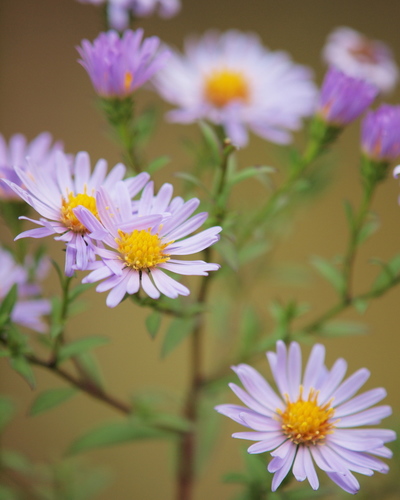
Flowers are grouped into heads called capitula, which are similar in structure to daisy flowers. These capitula are arranged in loose, flat-topped clusters called corymbs, each holding 20 to 30 capitula. Some plants produce several hundred capitula total, creating a full covering of flowers over the foliage. Each capitulum is around 40 to 50 mm in diameter, surrounded by a ring of 19 to 23 small, leaf-like protective bracts. Each bract is 6 to 9 mm long, tipped with a tiny dark point.
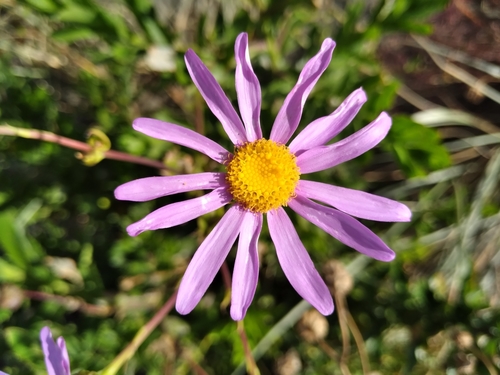
Each capitulum holds two types of flowers: central yellow disk florets that are 6 to 8 mm long, and outer petal-like ray florets that range in color from deep pink and purple to mauve or white. Most often, ray florets are bright pink, measuring 12 to 25 mm long, and arranged in a ring around the flower head.
The fruit of S. glastifolius is a dry, single-seeded structure called an achene, which is 2 to 2.5 mm long and dark brown. Achenes from ray florets are glabrous, while achenes from disk florets are hairy. Each seed is topped with a pappus, a tuft of fine, hair-like structures that aids wind dispersal. Each pappus is 7 to 9 mm long and detaches from the seed after dispersal. Senecio glastifolius is sometimes confused with Senecio elegans, which also grows along coasts, but the two species can be distinguished by their different leaf shapes.
This species is native to the coastal areas of South Africa’s Western and Eastern Cape Provinces, where it occupies a relatively small native range. It has been introduced to many other regions including Australia, the British Isles, New Zealand, Madeira, France, and the USA. In Australia, S. glastifolius is a listed weed on the National Environmental Alert list. In New Zealand, it is banned from sale and propagation, and managed as a pest.
In New Zealand, S. glastifolius was first recorded as naturalized in 1963 near Gisborne. It was initially of limited concern, but its population expanded significantly over the following 30 years. Today in New Zealand, it is widespread across coastal and lowland areas of the North Island, most commonly in the Manawatu and Whanganui region. It is also found in parts of the South Island around Canterbury and Marlborough.
It favors Mediterranean climates, is often found in coastal areas, and typically colonizes disturbed soil. It thrives in disturbed areas, and occurs in a wide range of habitats including coastal dunes, roadside embankments, rocky outcrops, damp areas, shrublands, and the open understory of forests. It can establish quickly after disturbances such as fire and land clearing.
Senecio glastifolius is classified as a short-lived perennial herb. Individual plants usually live between 3 and 5 years, though some larger plants in sheltered conditions have survived up to 10 years, meaning the species can live for a full decade. Seeds typically germinate within two weeks. Maximum germination occurs at temperatures above 25 degrees Celsius. Germination success generally ranges between 53% and 80%, and in New Zealand, germination has been observed from February to August. Disturbance from fire followed by rain can increase seedling germination. Seeds can remain dormant in soil seed banks for several years, and break dormancy in response to disturbance such as cultivation or fire. In Western Australia, plants follow the same growing season as New Zealand, growing between March and August. Flowering usually occurs in spring, though some plants in New Zealand have been observed to produce a second flush of flowers in summer. Each capitulum can produce up to 250 seeds, which are thought to be dispersed by wind. After flowering two to three times, plants often become top-heavy and break at the stem. Broken branches can continue growing, and there is evidence that horizontal stems in contact with soil can form new roots.