About Senecio flaccidus Less.
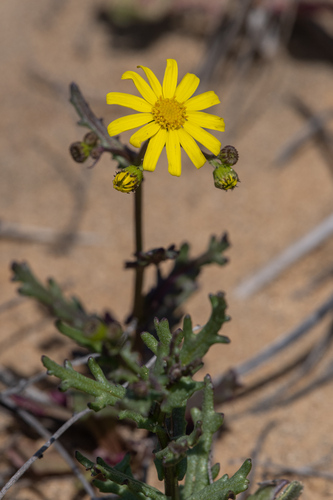
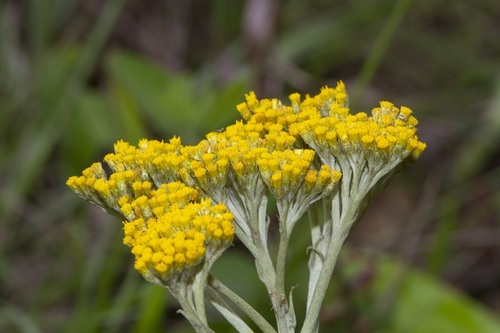
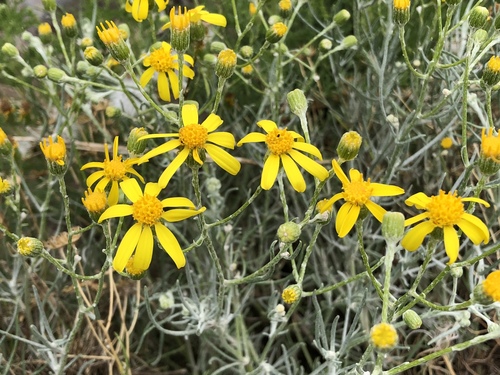
Threadleaf ragwort, with the scientific name Senecio flaccidus Less., is a fast-growing, short-lived bushy perennial shrub that lives 3 to 6 years and grows up to 4 feet 6 inches (1.37 m) tall. The whole plant is covered in dense, fine white wool. Its stems are grooved, and its branches are thin: herbaceous in the upper sections and woody near the base. Its leaves grow 1 to 5 inches (2.5 to 12.7 cm) long, are alternately arranged, and are deeply pinnate, divided into five to nine narrow lobes. The leaf blades are gray-green on the upper surface and covered in dense short hairs. Showy yellow flower heads bloom from April to September, measuring 3–4 inches (7.6–10.2 cm) across. These heads hold eight to thirteen sterile ray flowers, and purplish brown disk florets that produce seeds. As a dicot, the fruit of this species is an achene; each achene is 1⁄8 inch (3.2 mm) long, ribbed, hoary, and covered in short white hairs.
Senecio flaccidus is native to regions from central to southwestern United States, with its range overlapping the Great Plains. Its native range extends between Utah and Kansas, south to Arizona, New Mexico and Texas, and covers much of northern and central Mexico. Like other species in its genus, it prefers disturbed habitats, especially overgrazed rangelands, dried-up streambeds and desert grasslands. It grows at altitudes between 1,800 and 6,500 feet (550 and 1,980 m). It is common in gravelly washes, dry creek beds, and along roads and trails, and it mostly grows away from the coast. Its native distribution includes: in North-Central U.S.: Kansas, Oklahoma; in Northwestern U.S.: Colorado; in South-Central U.S.: New Mexico, Texas; in Southwestern U.S.: Arizona; in Northern Mexico: Chihuahua, Coahuila, Durango, San Luis Potosí, Sonora, Zacatecas; in Central Mexico: Aguascalientes, Guanajuato, Hidalgo, northeastern Jalisco, Veracruz. Its current recorded distribution includes: in North-Central U.S.: Kansas, Oklahoma, Wyoming; in Northwestern U.S.: Colorado; in South-Central U.S.: New Mexico, Texas; in Southwestern U.S.: Arizona, California, Nevada, Utah; in Northern Mexico: Chihuahua, Coahuila, Durango, San Luis Potosí, Sonora, Zacatecas, Baja California; in Central Mexico: Aguascalientes, Baja Norte, Guanajuato, Hidalgo, northeastern Jalisco, Veracruz.
As a colonizer of disturbed areas including overgrazed lands, Senecio flaccidus helps establish quick ground cover and stabilizes soil for longer-lived perennial plants. This species is poor forage for cattle and horses, because it contains alkaloids that cause liver disease when consumed in large quantities. Senecio flaccidus is also known as Senecio longilobus. Alkaloids found in this species include longilobine, senecionine, seneciphylline, florosenine, otonecine-based florosenine, and retrorsine.