About Senecio angulatus L.fil.
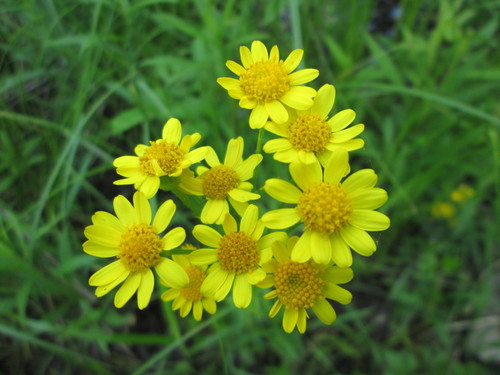
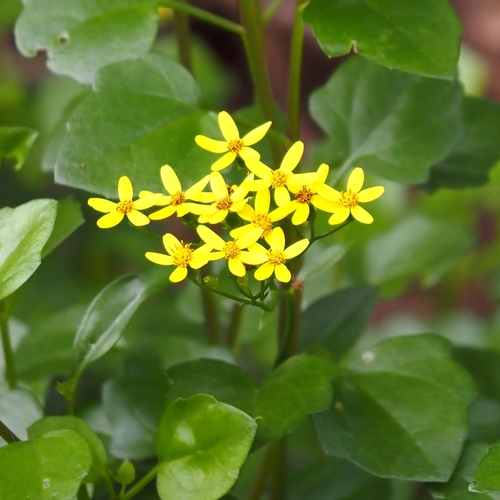
Senecio angulatus L.fil., commonly called creeping groundsel, Cape ivy, climbing groundsel, angled senecio, Algerian senecio, Jordanian senecio, and scrambling groundsel, is a succulent flowering plant in the Asteraceae family, native to South Africa. This scrambling herb can become an aggressive weed after establishment, so it is classed as an invasive species. It is cultivated as an ornamental plant for its satiny foliage and sweet-scented flowers. It is a problematic weed in New Zealand, and has become naturalised in parts of North Africa and Southern Europe. In Australia, the name Senecio tamoides is sometimes incorrectly applied to this species. Cape ivy is very similar in appearance to Delairea odorata, Senecio tamoides, and Senecio macroglossus.
This species is native to Cape Province, South Africa, where it grows scrambling over coastal brushwood and forest margins from East London to KwaZulu-Natal. Within its native South Africa, it occurs most commonly in Drakensberg grassland, Eastern Fynbos-Renosterveld, Southern Afrotemperate Forest, and Albany thickets. It has become naturalized in Mediterranean climate regions, including areas in or near the Mediterranean Basin: Southern Italy (Sardinia, Sicily), France (Corsica), Spain (including the Balearic Islands, Canary Islands, and Madeira), Croatia, Portugal, Albania, Tunisia, and Algeria. Outside the Mediterranean region, it grows in some coastal areas of southeastern Australia, particularly the Mornington Peninsula in southern Victoria, where it is actively spreading and listed as a significant environmental weed in Victoria. It is an emerging alien species in South Australia, Tasmania, the South Coast of New South Wales, and southern Western Australia. It is reported to be invasive in New Zealand, where it has naturalized in the Marlborough District and Chatham Island. It has been recorded escaping cultivation in California, Albania, and Chile. In California, it has an irregular wildland distribution, concentrated along the coast from Santa Barbara to the Mexico border.
The plant prefers black calcareous soils, grey sand, sandy clay, and limestone. It is most often found in coastal areas, growing on cliff faces, mudflats, wet depressions in dunes, around swamps, in landfills, in scrubland, and near human settlements. Due to its drought tolerance and succulent nature, Cape ivy grows well in Mediterranean climates, and has been cultivated in parts of North Africa, Southern Europe, and the Levant.
Phytochemical profiling of extracts of Senecio angulatus collected in Algeria has detected antioxidant and anti-acetylcholinesterase activities. Hydro-methanolic and acetate extracts showed antioxidant potential when tested with the FRAP and phenanthroline methods. A high amount of cynarin and trans-ferulic acid was found in these extracts, while butanolic infusions recorded the highest amount of chlorogenic acid. The hydroxyl groups common in phenolic compounds are believed to contribute to this antioxidant activity.