About Senecio ampullaceus Hook.
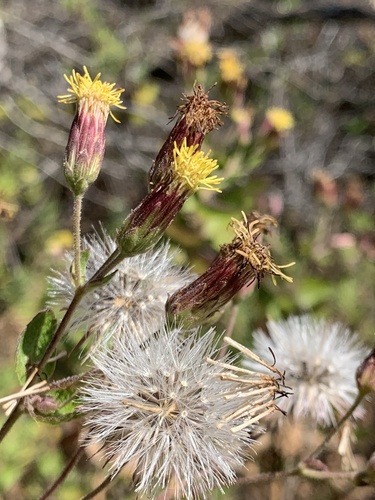
Senecio ampullaceus Hook., commonly known as Texas ragwort, is a tall annual plant. During the winter, its seedlings often have a purplish color on the undersides of their leaves, especially along the leaf midrib. It flowers in early to mid spring, and reaches a height between 20 cm (7.9 in) and 80 cm (31 in); it is similar in appearance to Senecio quaylei. This species grows from a single stem, with leaves that attach via broadly winged leaf stalks. Internodes between leaves grow progressively shorter higher up the stem. The leaves are ovate with pointed tips, with tapered bases; they measure 3 cm (1.2 in) to 10 cm (3.9 in) long, and 1.5 cm (0.59 in) to 4 cm (1.6 in) wide. On mature plants, lower leaves have more edge teeth than upper leaves. Stems and leaves are covered in a loose, uneven mat of fine hairs, and are occasionally hairless. Flowering stalks produce 10 to 30 flower heads, arranged in a flat-topped cluster. Each flower head is surrounded by 2 to 8 small bractlets, each 1 mm (0.039 in) to over 2 mm (0.079 in) long. Approximately 13 green to grayish bracts, 7 mm (0.28 in) to 10 mm (0.39 in) long, surround 8 ray florets and a corolla that measures 8 mm (0.31 in) to 10 mm (0.39 in). It produces single-seeded fruits with a rigid pappus. Its roots are relatively thin and branching. Senecio ampullaceus grows at altitudes from 100 m (330 ft) to 800 m (2,600 ft), and prefers open sandy or disturbed sites. Originally, it was native to the Nearctic realm, specifically to Missouri (north-central United States), Arkansas (southeastern United States), and Texas (south-central United States). Currently, it occurs in the Nearctic realm in Missouri, Oklahoma (north-central United States), Arkansas (southeastern United States), and Texas (south-central United States).