About Sempervivum montanum L.
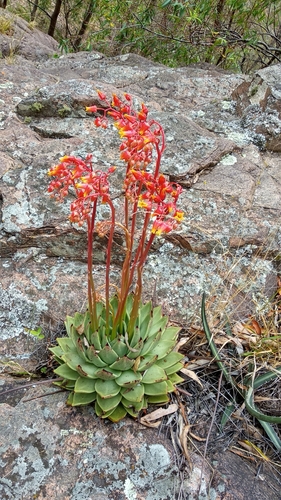
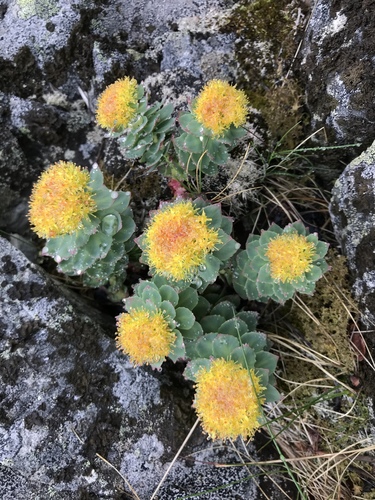
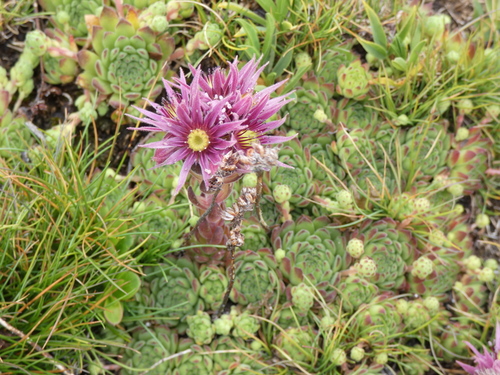
Identification: The genus Sempervivum is usually easy to recognize, although it may sometimes be confused with the genus Echeveria. However, identifying individual species within this genus is often difficult. Even a single clone can look very different when grown under various conditions, or at different times of the year. Members of this genus are very similar and closely related to one another. As a result, many subspecies, varieties, and forms have been described, with no well-defined boundaries between them. This also leads to a high frequency of natural hybrids within the genus, along with the possibility of back-crossing these hybrids. Roughly 40 species can be distinguished across the entire range of the genus, but there are many more local populations that do not have formal nomenclatural standing, though some have their own unique traits. In the Alps, the most widely distributed species are S. tectorum (common houseleek, sometimes called S. alpinum), S. montanum (mountain houseleek), and S. arachnoideum (cobwebbed houseleek), each with several subspecies. The yellow-flowered S. wulfenii and S. grandiflorum, as well as limestone houseleek (S. calcareum), have more restricted local ranges. S. dolomiticum and S. pittonii are even rarer; S. pittonii is endemic to Eastern Austria. S. tectorum can be found growing more or less wild on roofs or old walls far outside of its natural native range. It is a very old medicinal plant, as well as a plant associated with witchcraft, and some superstitious people believe it can protect a house from lightning. Habitat: Houseleeks are found from Morocco to Iran, occurring across the mountains of Iberia, the Alps, Carpathians, Balkan mountains, Turkey, and the Armenian mountains, as well as in the northeastern part of the Sahara Desert, and the Caucasus. Their ability to store water in their thick leaves lets them grow on sunny rocks and stony sites in the mountain, subalpine, and alpine belts. Most are hardy to USDA zone 4, and tolerate warm climates up to around zone 9. Growth and reproduction: Houseleeks grow in tufts of perennial, monocarpic rosettes. Each rosette can reproduce asexually via lateral rosettes called offsets (or "hen and chicks"), or (only for Jovibarba heuffelii) via rosette splitting; they can also reproduce sexually via tiny seeds. Typically, each individual rosette grows for several years before flowering. Their hermaphrodite flowers develop through a male stage first. After this stage, the stamens curve and spread away from the carpels at the flower's center, making self-pollination fairly difficult. Flower colors range from reddish, yellowish, pinkish, or rarely whitish. Flowers in the genus Sempervivum are actinomorphic (star-shaped) and have more than six petals, while flowers in the genus Jovibarba are campanulate (bell-shaped), pale green-yellow, and have six petals. After flowering, the parent rosette dies, usually leaving behind the many offsets it produced during its lifetime. In Food: Ibn Sayyar al-Warraq notes that houseleek juice, referred to by the medieval Arabic name bustan abrawiz, acts as a source of pink food coloring. It can also be mixed with saffron to produce a deeper yellow color than saffron alone produces.