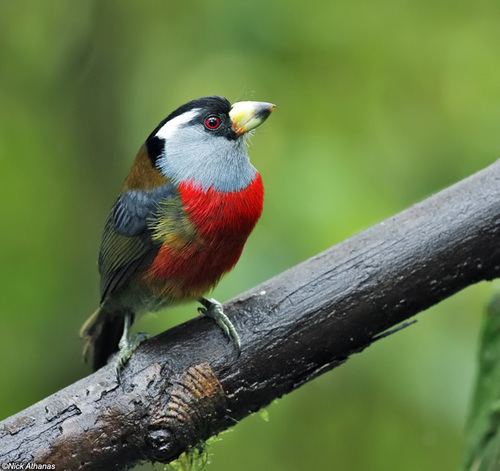
About Semnornis frantzii (P.L.Sclater, 1864)
Size and Weight
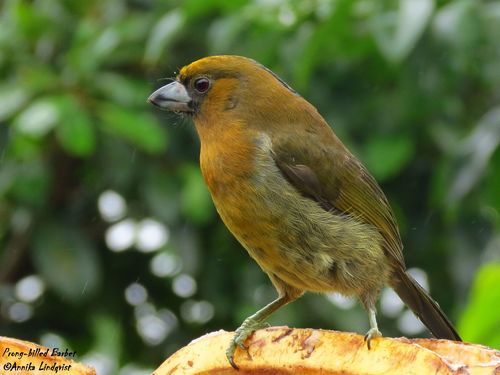
The prong-billed barbet (Semnornis frantzii) is 17 to 18.5 cm (6.7 to 7.3 in) long and weighs approximately 60 to 70 g (2.1 to 2.5 oz).
Bill Characteristics
Its bill ranges from silvery gray to bluish, with a dark tip; a notch on the tip of the mandible is the origin of its English common name. The maxilla has a hooked tip and a notch on its side.
Adult Upperparts Plumage
Adult birds have a dull golden brown crown, brownish olive nape and upper back, and olive green lower back, rump, and uppertail coverts.
Sexual Dimorphism
Males have a glossy black feather tuft at the rear of the crown, while females lack this feature.
Facial Plumage
Both sexes have dull slaty black lores, cheeks, and chin.
Underparts Plumage
The sides of the head, neck, and upper breast are buffy olive, which transitions to yellowish on the lower breast. The center of the belly is pale yellow, and the flanks are dull grayish with a pale yellowish wash.
Wing and Tail Plumage
The tail is dull green and the wings are dusky.
Immature Plumage
Immature birds are overall duller in color than adults, and the black facial areas of adults are grayer in immatures.
Geographical Distribution
The prong-billed barbet is distributed in mountainous areas from Costa Rica's Cordillera de Tilarán to Veraguas Province in western Panama.
Elevation Range
Its most common elevation range is 750 to 2,450 m (2,500 to 8,000 ft) on the Caribbean side of Costa Rica, 1,450 to 1,500 m (4,800 to 4,900 ft) on the Pacific side of Costa Rica, and 1,500 to 2,250 m (4,900 to 7,400 ft) in Panama. Locally, the species occurs at slightly lower elevations in both countries.
Habitat
It lives in the interior and edges of extremely humid montane evergreen forest, a landscape that hosts many epiphytes and mosses and experiences frequent fog.