About Selysiothemis nigra (Vander Linden, 1825)
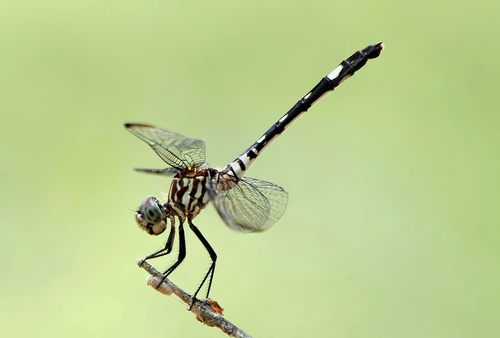
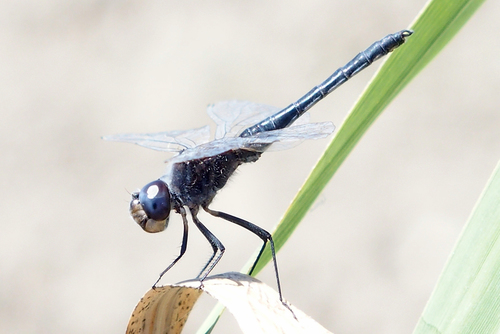
This species, Selysiothemis nigra, has an abdomen approximately 20 millimeters long. Fully mature colored males have entirely black abdomens, with a white dusting on the underside. In contrast, juvenile males and females are pale grey-yellow with distinct black markings. These black markings include a dorsal stripe on the second and third abdominal segments, along the transverse edges of these same segments. From segments four through seven, the dorsal stripe continues but is interrupted at the transition to the next segment, and also narrows at the middle of each of these segments. On the eighth through tenth segments, the dorsal stripe widens again. The upper abdominal appendages are shorter than the ninth abdominal segment, and when viewed from the side, they curve almost into a semicircle. The lower abdominal appendages are broad and blunt, and are only slightly shorter than the upper appendages. In adult males, the thorax is also black, the belly is whitish, and it bears white hairs. Females, meanwhile, are golden brown, and their color fades to whitish towards the lower portion. The legs are black, with yellowish white coloring on the coxae (hips) and the inside of the femora (thighs). The hind wings are around 25 millimeters long, and are transparent just like the forewings, with a white pterostigma (wing mark). The wing veins are white. For adult males, the lower lip (labium) is whitish, while it is yellowish white in juvenile males and females. The upper lip (labrum) is dull orange. The face and adjacent forehead (frons) are greyish olive. In adult males, this color darkens towards the middle, while in females and incompletely colored males it is greenish white. Incompletely colored males and females also have a sharply defined basal line on the forehead. The vertex is dark olive in color.