About Selenicereus spinulosus (DC.) Britton & Rose
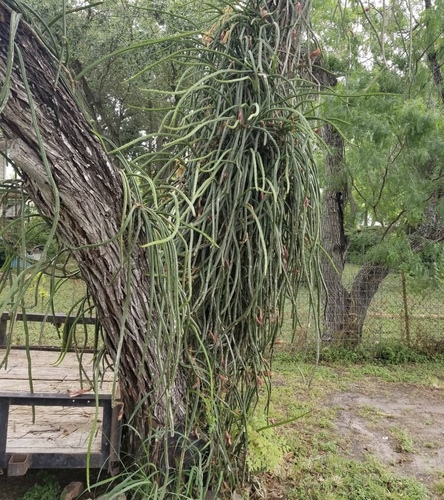
Selenicereus spinulosus (DC.) Britton & Rose has scandent, clambering or sprawling branching stems that produce aerial roots. Stems are stiff, reaching 1–2(-5) m long and 2–3 cm thick. They have 4–6 or more acute ribs that become terete with age. Areoles are 1.5–2 mm in diameter, reddish brown when young and turning greyish brown later, with internodes 1.5–2.5 cm long. There are 6–8 spines, 1 mm long, acicular, white or yellowish when new and becoming blackish over time: 5–6 are radial spines, and 1–2 are central spines. Above their swollen bulbous bases (which are 0.5 mm in diameter), spines are 0.25 mm in diameter, tapering to an attenuate-conical apex and circular in cross section; there are no hairlike spines. The epidermis is light green and somewhat shiny. Flowers develop from areoles near the stem tips, measuring 8–14 cm long and 7–8.5 cm in diameter. They are nocturnal but remain open for 2–3 days, according to John Ellis of the UK, with rotate tepals. The pericarpel is covered in spines with no hairs, and has small, triangular, reddish bracteoles. The receptacle is approximately 5 cm long, green, and bears clusters of 7–12 brownish spines 4–5 mm long, with no hairs. Outer tepals are 5.5–6 cm long, narrowly oblong, acute, and brownish. Inner tepals are 7.5 cm long and 11 mm wide, narrowly oblong, acute, and white, sometimes with a pink base or entirely pinkish. Stamens are white and much shorter than the inner tepals. The style is yellow, and has 9–11 stigma lobes. The fruit is globular, yellow, and densely covered with yellowish spines. This species occurs in eastern Mexico, from Tamaulipas to Chiapas. Other sources note its presence in the Mexican states of Coahuila, Nuevo León, and Tamaulipas, as well as the U.S. state of Texas. Plants were historically collected from the lower Rio Grande Valley of Texas, but this population may now be extirpated, as it has not been observed outside cultivation for some time. Selenicereus spinulosus most commonly grows on sun-exposed limestone outcrops, and also climbs on other plants in hillsides and submontane matorral (scrub) of the Sierra Madre Oriental. In cultivation, plants around 1 m long are able to flower. This species grows well in half-shade or full sun, in compost that contains plenty of peat. During the growing season, it requires ample water and regular fertilizer applications. It is fast-growing and free-flowering. It can be overwintered at 5 °C (41 °F) if kept dry, and is the easiest species of its genus to bring to flower in cultivation.