About Selenicereus grandiflorus (L.) Britton & Rose
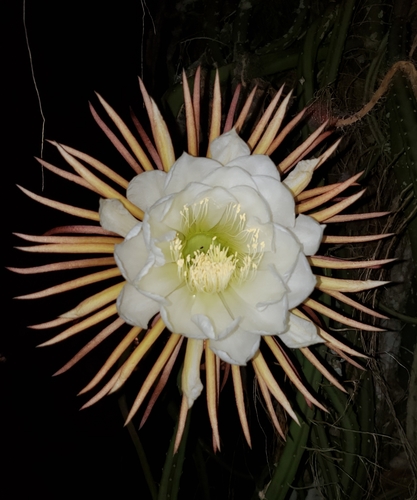
Selenicereus grandiflorus (L.) Britton & Rose has scandent, clambering or sprawling branching stems that sometimes form tangles, produce aerial roots, and are stiff. Stems grow to 10 m long or more, and are (10)15–25(–30) mm thick. Stems have (4–)7–8(–10) low ribs that are less prominent on older branches. Ribs are separated by broad, rounded intervals, with margins ranging from slightly wavy to strongly knobby. Areoles are small, covered in white or greyish-white wool; internodes measure (6–)12–20 mm. Each areole bears 5–18 spines, reaching 4.5–12 mm in length, with a basal diameter of approximately 0.25 mm. Spines are acicular, elliptic or circular in cross-section, bulbous at the base, spreading, and colored yellowish brown to brownish or yellow; they turn grey with age and are eventually deciduous. The lower part of the areole usually holds numerous white or brownish hairs; mature vegetative areoles typically lack these hairs, while juvenile plants have shorter, fewer spines. Stem epidermis is glaucous green or bluish green, often somewhat purplish, and smooth. Flowers are 17–22.5 cm long, and are reported to reach up to 38 cm (15 inches) in width. Their fragrance resembles a mix of vanilla and orange flower. The pericarpel is 25 mm long, with 5 mm long strap-shaped yellowish bracteoles, and is covered in nearly white or tawny hairs and sharp bristles. The receptacle is 7.5–8.7 cm long, with 5–14 mm long strap-shaped to linear yellowish bracteoles; the axils of these bracteoles hold long, roughly 25 mm long, wavy, nearly white or tawny hairs and sharp bristles. Outer tepals are 7.5–10 cm long, average 4.5 mm wide, linear-attenuate, light brown, salmon to pink buff, and yellowish on their adaxial surface. Inner tepals are 7.5–10 cm long, 9–12(–15) mm wide, shorter than outer tepals, wide, lanceolate, gradually narrowing to a pointed or acute apex, and white. Stamens are 38–50 mm long, declinate, and white; anthers are 1.5 mm long, and yellowish. The style is 15–20 cm long, often longer than the inner tepals, with a maximum diameter of 1.5 mm; there are 7–12 slender stigma lobes, around 7.5 mm long. Fruit is ovoid, 5–9 cm long, and 4.5–7 cm thick, with color ranging from whitish, partly pink, pink, yellow to orange. It is covered in clusters of spines and hairs that drop off early, is juicy, and has a small, inconspicuous umbilicus. Four subspecies are recognized: S. grandiflorus ssp. donkelaarii (Salm-Dyck) Ralf Bauer, S. grandiflorus ssp. grandiflorus, S. grandiflorus ssp. hondurensis (K.Schum. ex Weing.) Ralf Bauer, and S. grandiflorus ssp. lautneri Ralf Bauer. This species is native throughout the Greater Antilles (Cuba, Cayman Islands, Puerto Rico, Jamaica, the Dominican Republic, and Haiti), Mexico, Guatemala, Belize, Honduras, Nicaragua, and a few other locations in Central and South America. It grows climbing on trees and on rocks at an altitude of up to 700 metres. Its stems are extremely variable, especially in Jamaica, with slightly wavy to strongly knobby margins found on the same plant, which has caused confusion in cultivation. Many species placed in the genus Selenicereus are thought to be better treated as synonyms of subspecies of this species, differing only in degree of trait expression rather than in core traits. In cultivation, S. grandiflorus is a fast-growing epiphytic and lithophytic plant, though it takes two to three years to begin producing blooms. Cultivated specimens should be kept on the dry side each winter, and moved outdoors under a shade tree in late spring. They need compost that contains plenty of humus and sufficient moisture during the summer. Winter temperatures should not stay below 5 °C (41 °F), and the species performs best when grown in full sun. Extra light in early spring stimulates budding. It flowers in late spring or early summer; for its first several years of blooming, it only blooms one night a year, and blooms wither within hours.