About Selenicereus anthonyanus (Alexander) D.R.Hunt
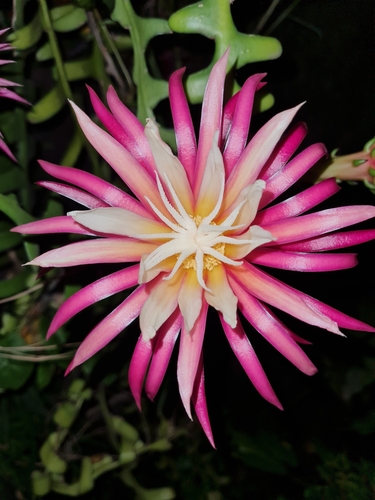
Selenicereus anthonyanus (Alexander) D.R.Hunt has ascending or climbing stems. Branches grow in clusters at intervals along the stem, reaching 1 m long or more, and 7–15 cm wide. They are flat with few aerial roots, and have deeply edged lobes that measure 25–45 mm long and 10–16 mm wide. These lobes taper somewhat toward a rounded apex. The plant has small areoles, and its epidermis is smooth, and ranges from green to yellowish green. Its fragrant flowers are 10 to 12 centimeters long and 15 to 17 centimeters across. The outer bracts are purple, spreading out until bent backward. Inner bracts are ascending, cream-colored, and turn yellow toward the flower throat. The seed vessel is 15–20 mm long and green. The pericarpel is covered in numerous small scales, along with gray wool, bristles, and thorns. Fruits are round or oval, growing up to 6 cm long, and are covered in thorny areolae that drop off as the fruit matures. Seeds measure 2 x 1.5 mm and are black. S. anthonyanus is endemic to moist lowland rainforest in southern Mexico, occurring in the states of Chiapas, Oaxaca, Tabasco, and Veracruz, and growing at altitudes between 180 metres (590 ft) and 500 metres (1,600 ft). This species is an easily cultivated, fast-growing epiphyte. It requires compost with plenty of humus and sufficient moisture during the summer. It can be grown in semi-shade or full sun, but must not be kept at temperatures below 4 °C (39 °F) in winter. Extra light in early spring will stimulate budding. Its flowers only open for one night, are highly fragrant to attract nocturnal pollinators, and bloom in late spring or early summer.