About Selenia tetralunaria (Hufnagel, 1767)
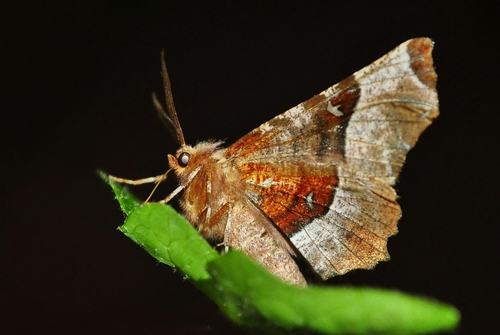
The purple thorn, with the scientific name Selenia tetralunaria, is a moth belonging to the family Geometridae. It was first formally described by Johann Siegfried Hufnagel in 1767. This species is found across Northern Europe and Central Europe. In Britain it has a scattered distribution, and it is not present in Ireland. The adult moth is dark purplish brown, with coloration growing paler toward the wing termen, and it has a dark spot at the apex of the forewing. Both the forewings and hindwings bear a comma-shaped white mark. The wing margins are angular, which gives the moth a distinctive overall shape. This species produces two broods per year, and the two generations differ substantially in size and color. Adults from the spring brood fly during April and May, and have a wingspan of 46 to 52 millimeters. Moths from the summer brood fly during July and August, and are smaller with a wingspan of 44 to 46 millimeters, and darker in color. The caterpillar is reddish brown, mottled with darker brown, and has pale greyish markings. Adult purple thorn moths fly at night and are attracted to light. The caterpillars feed on a range of tree and shrub species, which are: alder (Alnus), birch (Betula), European ash (Fraxinus), apple (Malus), black poplar (Populus), Prunus, pear (Pyrus), oak (Quercus), and rose (Rosa). This species overwinters in the pupal stage.