About Selaginella selaginoides (L.) Schrank & C.F.P.Mart.
Selaginella selaginoides (L.) Schrank & C.F.P.Mart. is a small, delicate, low-growing plant.
Sterile Stem Features
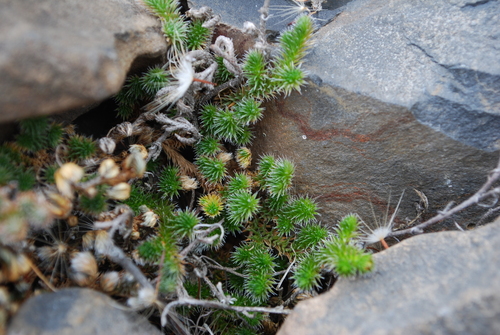
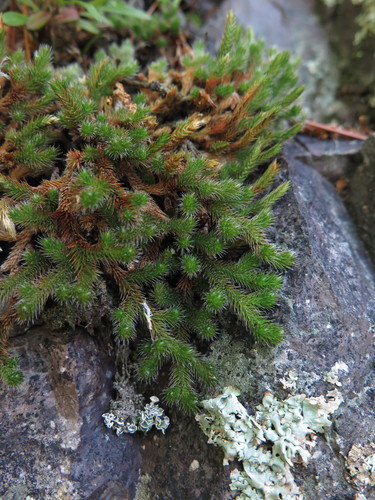
Its perennial sterile stems are short, slender, and irregularly branched, reaching up to 15 cm in length. These stems creep along the ground, and typically turn upward near their tips.
Sterile Leaf Traits
They bear small, pointed, triangular leaves around 1–2 mm long; each leaf has a ligule on its upper surface near the base.
Fertile Shoot Characteristics
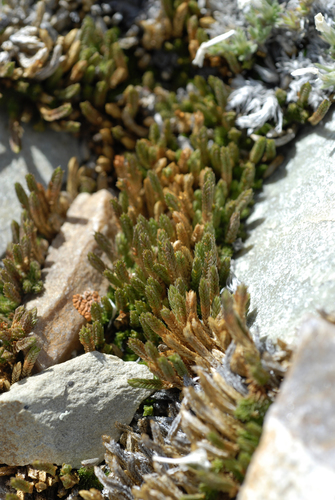
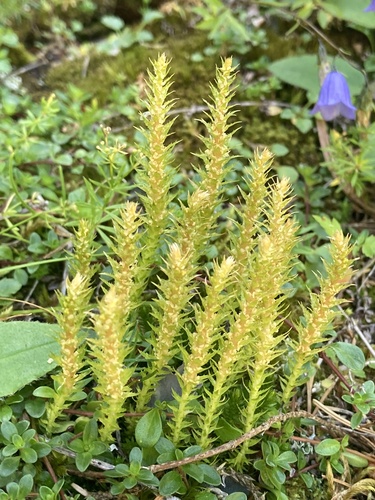
This species also produces annual fertile shoots that are more robust than sterile stems and grow erect. Fertile shoots are usually 3–6 cm tall and 4–6 mm across, but can reach 10 cm in height when growing conditions are favorable.
Fertile Shoot Leaves
Their leaves are slightly longer than the leaves of sterile stems, arranged spirally around the stem and pointing upward.
Cone and Sporangia Details
Fertile shoots bear stout, yellowish cones that are only slightly differentiated from the branch. The cones most often hold two types of sporangia: lobed megasporangia in the lower section of the cone that produce megaspores, and simple microsporangia in the upper section that produce many tiny microspores.
Global Distribution Range
This species has a near-circumpolar distribution in the northern hemisphere, occurring across northern parts of Europe, Asia, and North America, including Greenland, Iceland, and the Faroe Islands. In Europe, its range extends south to the Pyrenees, Apennines, and Caucasus.
Regional Distribution Limits
In Asia it reaches as far south as Japan, while in North America it extends south to Nevada, Wisconsin, Michigan, and Maine.
Habitat Preferences
It grows in damp locations with neutral to alkaline soils, and is most commonly found in mountainous areas. Habitats it inhabits include bogs, the shores of streams and lakes, wet cliffs and ledges, grassland, and dune slacks.
Competitive Traits
It is a poor competitor that cannot grow in areas with tall, dense vegetation.
Elevation Ranges
In North America, it mainly grows at elevations between 600 and 2900 m above sea level, and occasionally reaches 3800 m. In Britain, it has been recorded from sea level up to 1170 m.
Global Conservation Status
The species is not considered globally threatened, but it has declined in some regions due to drainage and habitat destruction.
British Range Decline
By 1930, it had mostly disappeared from lowland areas of Britain and Ireland, and there is some evidence of range contraction in the region's uplands as well.
Finnish Habitat Loss
In Southern Finland, the loss of rich fens caused by ditch drainage and conversion of meadows to fields or lawns has led to the disappearance of suitable habitat for this plant.
Traditional Medicinal Use
In Finnish traditional medicine, this plant was historically used as a remedy for rickets.