About Seiurus aurocapilla (Linnaeus, 1766)
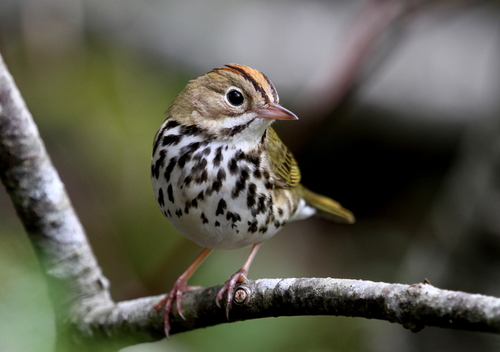
Ovenbirds, scientifically named Seiurus aurocapilla (Linnaeus, 1766), are large wood warblers. Untrained observers may sometimes confuse them for thrushes. Adult ovenbirds measure 11–16 cm (4.3–6.3 in) in total length, with a wingspan of 19–26 cm (7.5–10.2 in). They average 19 g (0.67 oz) in weight, with a total weight range of 14–28.8 g (0.49–1.02 oz). For standard body measurements, the wing chord is 6.8 to 8.3 cm (2.7 to 3.3 in), the tail is 5 to 5.8 cm (2.0 to 2.3 in), the bill is 1.1 to 1.3 cm (0.43 to 0.51 in), and the tarsus is 2 to 2.3 cm (0.79 to 0.91 in). Ovenbirds are typically heavier in winter, and particularly heavy at the start of their migration. They have olive-brown upperparts and white underparts that are heavily streaked with black, and their flanks carry an olive hue. A white ring surrounds each eye, and a black stripe runs below the cheek. A line of orange feathers with olive-green tips runs along the top of the head, bordered on each side by blackish-brown. The orange feathers can be erected to form a small crest. The eyes and upper part of the thin pointed beak are dark, while the lower beak is horn-colored, and the legs and feet are pinkish. Males and females have identical plumage. Immature birds have tawny fringes on their tertiary remiges, and sometimes have buff-tipped outer primary wing coverts. Most noticeably, the olive-green tips of the crown feathers, which are barely visible in adult birds, are far larger in immature birds and cover almost or all of the orange crown stripe. The main song of the ovenbird is a series of strident, relatively low-pitched, two-syllable phrases that are repeated without pause around eight times, increasing in volume. Usually, the second syllable of each phrase is sharply accented, sounding like: "chur-tee' chur-tee' chur-tee' chur-tee' chur-TEE chur-TEE chur-TEE!". Male ovenbirds produce a sweet chattering song while flying in the air at twilight, in a similar manner to skylarks. They incorporate portions of the main song into a jumble of sputtering notes and mimicry as they dive back down to the ground. The ovenbird's call is a sharp "chik!" of variable pitch; some variations resemble the common call note of a downy woodpecker. If an ovenbird is excited, it may repeat this call multiple times. Its fight call is a high, rising siiii. Their breeding habitat is mature deciduous and mixed forests, especially sites with little undergrowth, across Canada and the eastern United States. Ovenbirds prefer woodland with abundant shrub undergrowth for foraging, and essentially thrive best in a mix of primary and secondary forest. Ovenbirds are migratory, traveling to the southeastern United States, the Caribbean, and the region from Mexico to northern South America for the non-breeding season. These birds are territorial year-round, occurring either singly or, during the breeding season, as mated pairs that are briefly accompanied by their young. During migration, however, they tend to travel in larger groups, dispersing again once they reach their destination. In winter, they live mainly in lowlands, but may climb up to 1,500 m (4,900 ft) above sea level, for example in Costa Rica. The first migrating ovenbirds leave breeding grounds in late August, and can appear on wintering grounds as early as September, with successive waves of migrants arriving until around late October. They depart wintering grounds to travel to breeding areas between late March and early May, arriving on breeding grounds throughout April and May. Migration timing does not appear to have changed much over the course of the 20th century. This species is an infrequent vagrant to Europe, with five individuals reported in the Azores in this century, and a small number of records in Norway, Ireland, Romania, and Great Britain. A live ovenbird found on St Mary's, Isles of Scilly in October 2004 was in poor condition, and died despite being taken into care. Ovenbirds are also regular vagrants in California. Ovenbirds forage on the ground among dead leaves, and sometimes hover or catch insects in flight. This bird frequently tilts its tail upward and bobs its head while walking. When at rest, it may flick its tail upward and lower it slowly again, and alarmed birds flick their tails frequently from a half-raised position. These birds mainly eat terrestrial arthropods and snails, and also add fruit to their diet during winter.