About Sedum lanceolatum Torr.
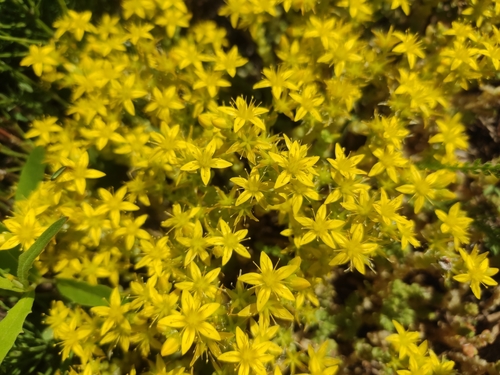
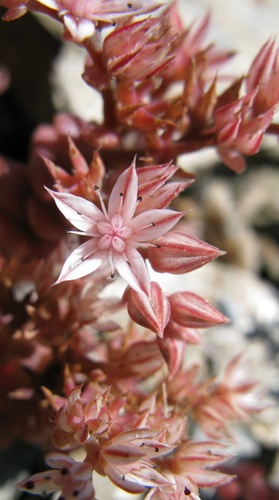
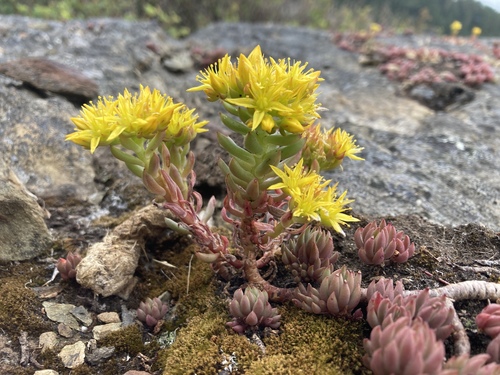
Sedum lanceolatum Torr., commonly called lanceleaf stonecrop, is a very short succulent plant. Each individual produces numerous branching sterile stems that hold tight clusters of leaves; these stems grow both decumbent (along the ground surface) and ascending (curving upward), with a leaf rosette at the tip of each stem. Branchlets break apart easily. Each stem is biennial, and is replaced by new plant offsets. Leaves attach to stems in a spiral arrangement and do not detach easily from stems. Leaves are subterete, meaning they are nearly circular in cross-section, and can be lanceolate, elliptic-lanceolate, or elliptic-ovate in outline. They are quite small, measuring only 4.2 to 13 millimeters long and 1.5 to 3.5 millimeters wide. Leaf color varies with sun exposure: maroon when grown in full strong sun, and dull dark gray-green in less exposed locations. Erect flowering stems grow 3 to 18 centimeters (1.2 to 7.1 inches) tall. Leaves attach alternately to flowering stems, and often drop off before flowers open. The inflorescence is a flat-topped cluster of yellow flowers, called a branched cyme (a type of determinate inflorescence). Each flowering stem holds anywhere from 3 to 25 flowers, which may be packed loosely or densely. The flower petals range from canary yellow to golden yellow, and are sometimes tinged with red, especially along the central petal rib. Flowers most often have five petals and five sepals, but occasionally have only four. Petals are longer than sepals, typically 6 to 9.2 millimeters long, and occasionally as short as 5.5 millimeters, with a lanceolate to ovate shape. Flowers have ten stamens tipped with yellow anthers, and most often five carpels, occasionally four. The central flower on a stem is noticeably larger than the other flowers. This species reproduces both sexually via tiny, lightweight seeds, and vegetatively when broken stem sections root and grow into new plants. Seeds are about 1 millimeter in size, and range from brown to dark brown in color. It can be distinguished from the related narrow-petaled stonecrop (Sedum stenopetalum) by the leaf underside ridge that is present in S. stenopetalum but absent in S. lanceolatum. Lanceleaf stonecrop is native to much of western North America, ranging from Alaska south to New Mexico. In Canada, it has been recorded in Yukon Territory, British Columbia, Alberta, and Saskatchewan. In the Pacific Northwest, it grows across most of Washington, Oregon, and Idaho. East of the Pacific Northwest across the Rocky Mountains, it has only been recorded from three counties in Montana. It grows in five counties in the Black Hills of southwest South Dakota, and is only found in Sioux County on the western edge of Nebraska. It occurs in all but two counties of Wyoming, and the western two-thirds of Colorado, and is restricted to the northwestern part of New Mexico. In the Southwestern United States, it grows throughout all of Utah, in northeastern Arizona, across many parts of Nevada, and in the high Sierra Nevada ranges, Klamath Ranges, and high Cascade Mountains in California. The full extent of its native range is not confirmed, but its estimated extent is between 20,000 and 2,500,000 square kilometers (8,000 and 965,000 square miles). It grows on stony outcrops, dry rocky slopes, and areas of lithosol (thin, poorly developed soil). It is associated with many different rock types, including limestone, sandstone, marble, andesite, basalt, granodiorite, and granite. However botanist Charles Uhl reports that it is uncommon, and may be entirely absent, from basaltic rocks and lava outcroppings. It is strongly associated with alpine tundra and the subalpine zone along the North American Cordillera, but can also be found in many other habitats, including gravelly sites on the Great Plains adjacent to mountains. It also occurs in sunny, open stony locations in sagebrush steppes, piñon–juniper woodlands, mountain brush, ponderosa pine forests, interior Douglass-fir forests, aspen groves, spruce–fir forests, and lodgepole pine communities. In large parts of its range, Sedum lanceolatum is almost the only host plant for the Rocky Mountain apollo butterfly (Parnassius smintheus). The plant produces a cyanoglycoside deterrent called sarmentosin, which discourages most herbivores from feeding on it. Larvae of the Rocky Mountain apollo butterfly sequester this sarmentosin from the plant for their own defensive protection. Research has found that if the plant is physically damaged by mechanical means, larvae feeding on it have slower growth rates, possibly due to an induced defensive response from the plant. As a result, larvae often feed quickly before moving to another plant within the window when the plant has the highest nutritional quality. Larvae typically feed on a plant and leave it in less than half an hour. From November to February, the leaves of this plant are fatally toxic to Rocky Mountain apollo larvae; larvae feed and develop normally on the leaves for the rest of the year. If snow melts before March, butterfly eggs hatch while the plant is still toxic, and all larvae die. Lanceleaf stonecrop is a drought-tolerant species that is planted in rock gardens. It is a rare species in the commercial plant trade, and is usually only available from specialist plant sources in Europe. It tends to spread slowly, and is difficult to grow in regions with high rainfall.