About Sedum candollei Raym.-Hamet
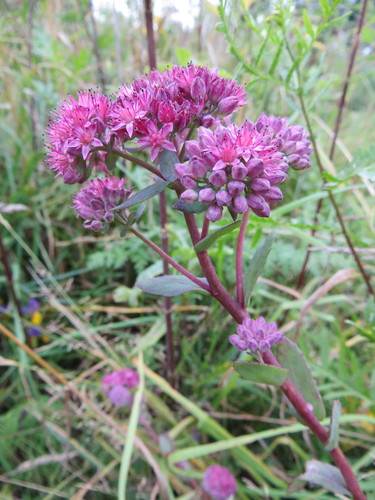
This entry lists the scientific name Sedum candollei Raym.-Hamet, and provides details for Hylotelephium telephium, which has the synonym Sedum telephium. Hylotelephium telephium is known by many common names: orpine, livelong, frog's-stomach, harping Johnny, life-everlasting, live-forever, midsummer-men, Orphan John, witch's moneybags, and garden stonecrop. It is a succulent perennial plant in the family Crassulaceae, native to Eurasia. Its flowers grow in dense heads, and can be reddish or yellowish-white in color. Many cultivars, often with purplish leaves, are grown in gardens, along with hybrids between this species and the closely related Hylotelephium spectabile (iceplant). The hybrid 'Herbstfreude', also called 'Autumn Joy', is particularly popular. Occasionally, cultivated garden plants escape cultivation and become naturalized in new areas, which has already occurred in parts of North America. The species is naturally distributed from Europe to Asia, and has been widely introduced to other regions, most notably North America. It grows in fields, around hedges, on hills, and in gravelly or calcareous soils. In the United Kingdom, it can also be found in woodland and near hedges. For consumption, the very young leaves of Hylotelephium telephium can be eaten raw, and both young leaves and firm tubers can be cooked. The plant has a history of medicinal use: Romans used it to treat wounds, and it was used in later periods to treat internal ulcers. It has also been used for love divination, a practice that inspired its common name 'livelong'. Because the cut stems and leaves can retain stored water after picking, they were hung in a room where a girl awaited marriage to a boy. If the stems grew together, this was taken as a sign that the marriage would be blessed and the girl would be happy. If the stems grew apart, this indicated poor marriage prospects; if a stem died, it was seen as an omen of death.