About Sedum acre L.
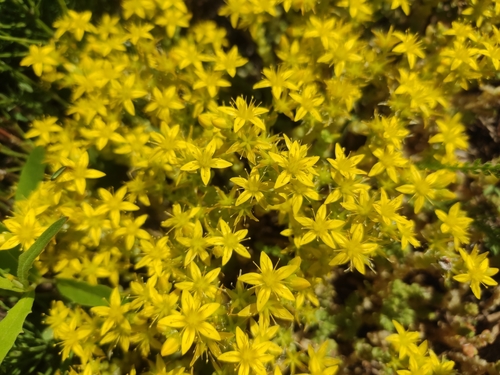
Sedum acre L., commonly known as biting stonecrop, is an evergreen perennial that forms tufted, mat-like stands growing 5 to 12 cm (2 to 5 inches) tall. For most of the year, its stems are short, semi-prostrate, and densely covered in leaves. When flowering in June and July, stems lengthen, becoming erect, somewhat limp, and often pinkish-brown, with leaves spaced further apart. The alternate leaves are fleshy, shortly cylindrical with a rounded tip, and are sometimes tinged red. Its starry flowers are arranged in a cyme holding 3 to 6 individual flowers. The calyx has five fleshy sepals fused at the base, the corolla consists of five regular bright yellow petals, with 10 stamens, a separate gynoecium, and five pistils. The fruit is made up of five united, many-seeded follicles. The leaves contain an acrid fluid that can cause skin rashes. This low-growing species cannot compete with more vigorous, faster-growing plants. It is specially adapted to grow on thin dry soils, and can be found in dry grassland, shingle, beaches, drystone walls, dry banks, seashore rocks, roadside verges, wasteland, and sandy meadows near the sea. When left undisturbed, biting stonecrop spreads, but it is easily controlled thanks to its shallow roots. It is used in hanging baskets and container gardens, as a trailing accent, in borders, or as groundcover. It grows as a creeping ground cover, often in dry sandy soil, and also grows in the cracks of masonry. It thrives in poor soils, sand, rock gardens, and rich garden soil, across a range of light levels. Biting stonecrop has a peppery taste, which gives it the common name "biting", and it is sometimes used in herbal medicine. However, it is considered poisonous, and consumption is discouraged.