About Searsia lucida (L.) F.A.Barkley
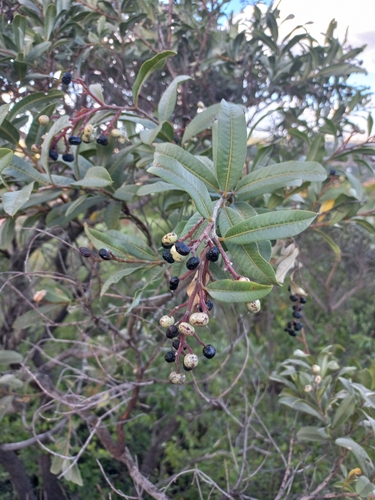
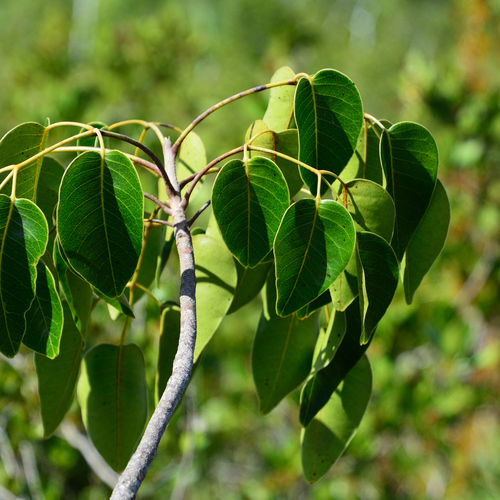
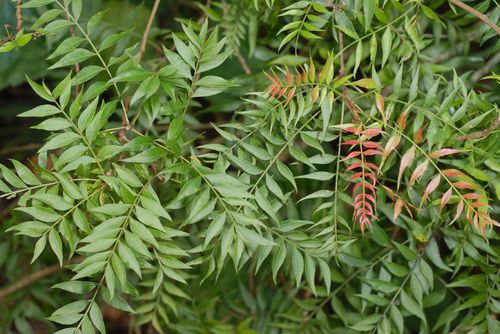
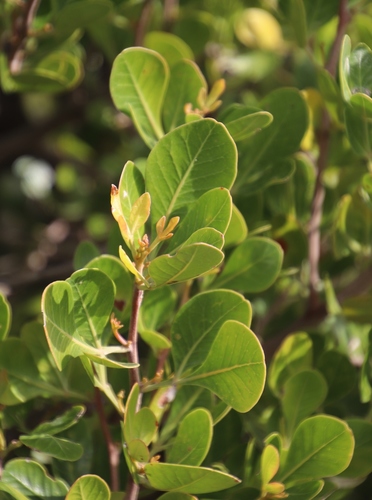
This species, Searsia lucida (L.) F.A.Barkley, most often grows as a spreading shrub that can extend several meters across, and rarely grows as a tree taller than 2 meters. Its stems and branches grow upright and erect. Young stems are red, shiny, resinous, and sticky. The epithet "lucida" means "shiny," referring to the plant's leaves, which are trifoliate, leathery (sub-coriaceous), and dark to olive green in color. Leaves often turn orange before they are shed. Leaflets are obovate-cuneate in shape, and their rounded tips often have small notches. Leaflets are the same color on both upper and lower surfaces, with a prominent central midrib and visible fine lateral veins. Damaged leaf surfaces turn pale, almost white. The leaf petiole (leaf stalk) is slightly winged, at least along its upper half. From June to October, Searsia lucida produces small, creamy-white flowers in small, sparse terminal inflorescences. Flower petals are less than 2 mm long. The plant bears spherical fruits 4–5 mm in diameter that are green when young and turn shiny brown when they mature between October and November. Birds eat these fruits. This small tree grows along the West Coast of South Africa, ranging from Saldanha Bay around the Cape and up the East Coast almost to the Mozambique border. Its range also includes all of Kwazulu-Natal and Lesotho, extends past Eswatini, and continues north through the Lowveld areas of Mpumalanga into Limpopo Province and Zimbabwe. It occurs in scrub or forest habitat from sea level up to 2000 metres in elevation.