About Scutellaria galericulata L.
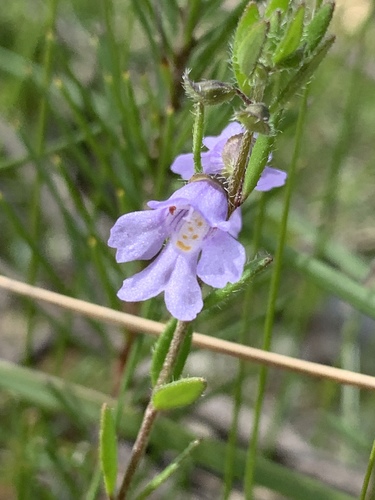
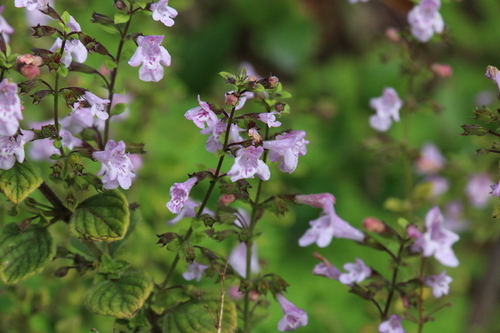
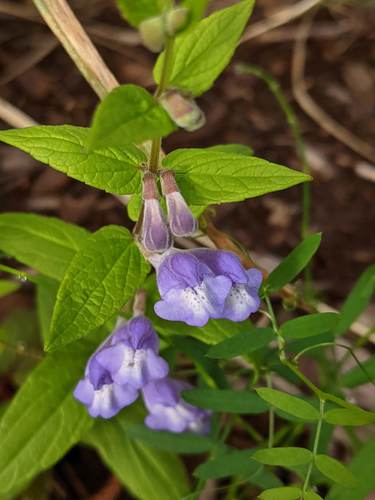
Scutellaria galericulata L., commonly called common skullcap, marsh skullcap, or hooded skullcap, is a hardy perennial herb in the mint family. It is native to northern regions of the Northern Hemisphere, including Europe, Asia, and almost all of Canada. This plant grows in an upright form; it typically reaches 20 to 45 centimeters in height, and can sometimes grow as tall as 80 centimeters. It prefers wetland habitats, growing along fens and shorelines. Its blue flowers measure 1 to 2 centimeters long. The flowers grow in pairs, all located on the same side of the stem, and do not form at the very top of the stem. Because this species is native to many regions across the globe, it has acquired a wide variety of common names. The specific epithet galericulata is Latin for "hooded", a reference to the flower tube being much longer than its calyx. The former variant name epilobiifolia translates to "leaves like willow-herb", referring to its slightly serrated, long thin leaves that resemble leaves of the genus Epilobium. The entire Scutellaria (skullcap) genus has many documented medicinal uses, and different skullcap species are often used in similar ways. There are more than 200 distinct skullcap species, and their uses are not all identical, so the traditional uses of common skullcap should not be conflated with uses of other skullcap species. Blue skullcap (S. lateriflora) is the species recognized as the "skullcap" used in traditional North American medicine. However, common skullcap shares many of the same active chemicals, and is used as a substitute for blue skullcap in Britain and Europe. Common skullcap (S. galericulata) is also often used in the same way as the genetically similar Western skullcap (S. canescens) and Southern skullcap (S. cordifolia). Blue skullcap and common skullcap are best known for their traditional use as mild anxiolytics. They are prepared as herbal teas, tablets, capsules, dried leaf for smoking, and oral liquid preparations, and are often combined with other medicinal herbs. Native Americans have traditionally used the aqueous extract from the flowering parts of these plants as a nerve tonic, and to obtain its sedative and diuretic effects.