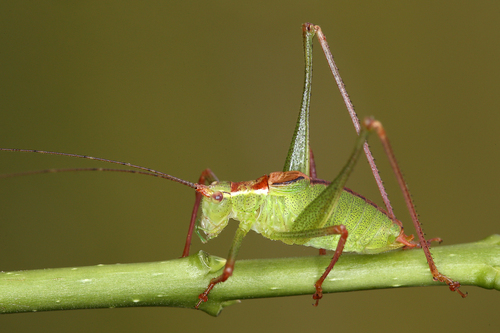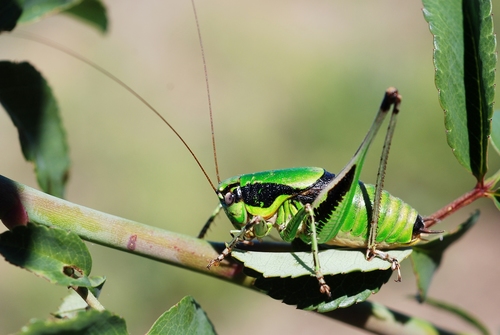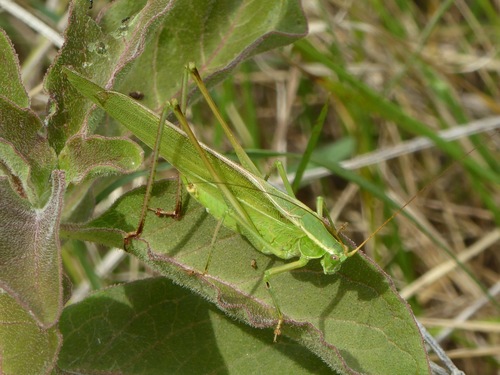
About Scudderia texensis Saussure & Pictet, 1897
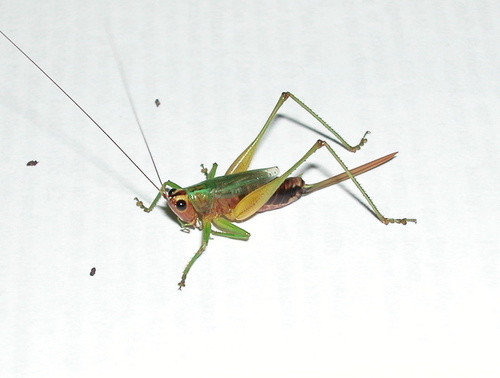
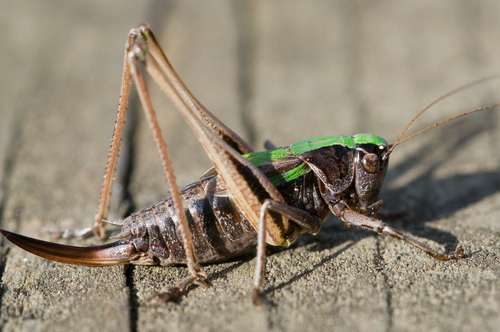
Scudderia texensis, commonly called the Texas bush katydid, has an overall body length ranging from 40 to 56 mm. Much of this species’ size variation is tied to geography. Female Texas bush katydids can be identified by the right angle between the basal and terminal portions of their ovipositor. In males, the sub-genital plate bears an upcurved ventral process that meets a dorsal extension of the supra-anal plate; this dorsal process ends in a pair of curved indentations that form a small central tooth.
Scudderia texensis is distributed across the entire eastern United States, and also occurs in adjacent Canada, extending west to the western edge of the Great Plains. It inhabits grasslands, deciduous forests, and shrublands, and is particularly abundant in weedy old fields and roadsides. Across most of its range, it is the most abundant species within the genus Scudderia. Adults are most numerous from late spring or summer through autumn, and often survive until the first hard freezes.
In the southern part of its range, S. texensis produces two generations per year: the first generation matures in late spring, and the second matures in early fall. In the northern part of its range, there is only one generation per year, which matures in late summer. In addition to geography, size variation also depends on the number of generations and the length of the growing season. In the two-generation region of the range, stretching from Florida to North Carolina, the average adult size is 44 mm. The southernmost extent of the single-generation range is Virginia, where the average size is about 52 mm. At the northern extreme of the range in Michigan, the average size is also about 44 mm. Research shows that adult size correlates with how quickly individuals must mature to fully use the growing season while producing the maximum possible number of generations.