About Scotopelia peli Bonaparte, 1850
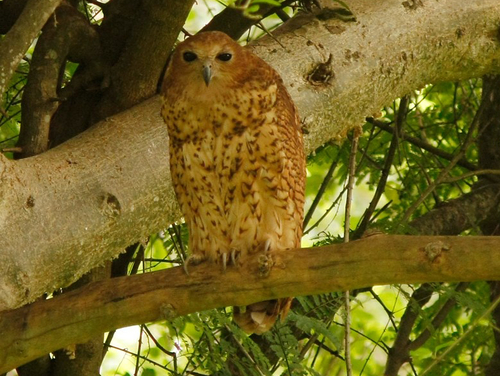
Pel's fishing owl (Scotopelia peli Bonaparte, 1850) is one of the largest owl species in the world. On average, it ranks as the fifth-heaviest owl globally, the seventh-longest in both total length and measured wing chord, and the fourth-longest in mean wingspan. Note that wingspan measurements are not available for all large owl species. This species has a total length of 51–63 cm (20–25 in), a wingspan around 153 cm (60 in), and can reach a weight of at least 2.35 kg (5.2 lb). One recorded male weighed 1.72 kg (3.8 lb), and four recorded females averaged 2.19 kg (4.8 lb). On average, this species may be heavier than the snowy owl — the snowy owl is only around 4% lighter on average across six datasets — placing Pel's fishing owl as the fifth- or sixth-heaviest living owl on average. Under current classification, Pel's fishing owl is the heaviest living owl not belonging to the genus Bubo, though some authors group fishing owls into the genus Bubo. Standard measurements for the species are 40.7–44.7 cm (16.0–17.6 in) for wing chord, and 20.7–24.3 cm (8.1–9.6 in) for tail length. This species is well adapted to its aquatic hunting lifestyle. Unlike most owls, it has very little feathering on its toes and tarsi, which minimizes how much plumage gets wet when it fishes. Like diurnal raptors that specialize in catching fish, it has spiky scales on the undersides of its feet that help it grip slippery fish. Because strong hearing and auditory stealth are not important to this owl's hunting strategy, it does not have keen hearing, nor does it have the soft feather edges on its flight feathers that most owls have. This makes Pel's fishing owl nearly impossible to hear when flying. Adult Pel's fishing owls are a rich ginger-rufous color, with dense dark barring on their upperparts and dark scaling on their underparts. The feathers around the head are loose and long, creating a shaggy appearance. The unfeathered tarsi and toes are straw-colored. The white throat patch is often mostly hidden, but it can be puffed up when displaying during courtship. The flight and tail feathers have alternating lighter and darker bars. The eyes are distinctly dark, often appearing blackish. Adult males and females look similar overall, but females are generally less rufous in color and have a more indistinct facial disc. There is considerable individual variation in adult coloration and barring: some adults have extensive pale feathers, while others have multiple blackish markings. Juveniles are more uniformly buff-colored than adults. Compared to eagle-owls, Pel's fishing owl has barely visible ear tufts, which gives it a very round-headed look. The two smaller related fishing owl species are smaller overall, and lack the dark barring and scaling seen on Pel's fishing owl, though they do have dark streaks on their underparts. The male Pel's fishing owl's song is a deep, resonant, horn-like boom, starting with a single note followed by a higher-pitched huhuhu. Males also produce a ringed hoot that is much higher pitched than the hoots of most eagle-owls, followed by a deep, soft grunt, rendered as whoommmm-wot or hooomm-hut. Male calls are repeated every 10 to 20 seconds, and can be heard from distances up to 3 km (1.9 mi) away. When singing, males often inflate their throat and breast considerably. Female songs are similar to males, but higher pitched, and are often given as a double note (hoot-oot). Females and young at the nest produce a shrill wheeoouu wail when they are waiting for food. This species occurs across much of sub-Saharan Africa, but it is generally quite localized, uncommon, and entirely absent from drier regions. It has a patchy distribution in Nigeria, Senegal, the Gambia, Guinea, and Sierra Leone; in central Africa it ranges from the coast to eastern Zaire, and extends discontinuously further east to South Sudan, Somalia, Kenya, and Tanzania, and south to Zambia, Zimbabwe, Botswana, and eastern South Africa. Pel's fishing owl inhabits forests located alongside rivers and lakes. It can also be found in swamps and estuaries, ranging from sea level up to around 1,700 m (5,600 ft) in elevation. Its preferred habitat is riverine forests with large trees, though large populations also occur on islands with large, mature trees within larger rivers, swamps, or lakes, as long as the islands are not too far from the bank. The species is largely non-migratory and resident, with no regular seasonal movement. Young nonbreeding birds may wander short distances before they claim their own territories, and Pel's fishing owls may move outside their normal range when chasing prey.