About Scopula marginepunctata (Göze, 1781)
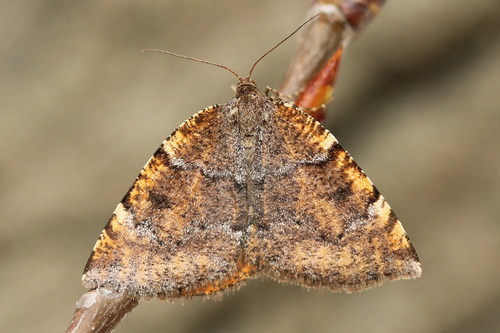
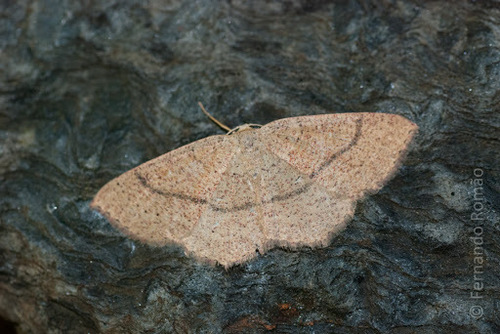
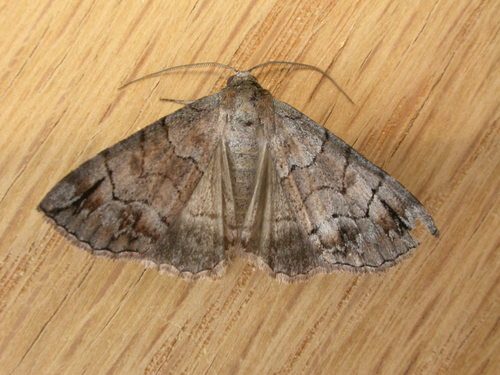
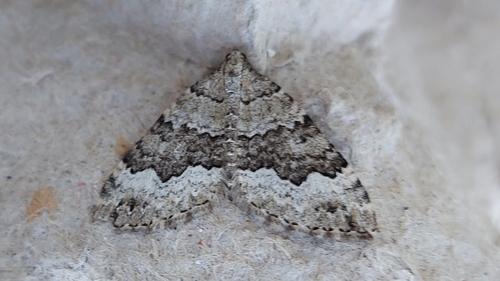
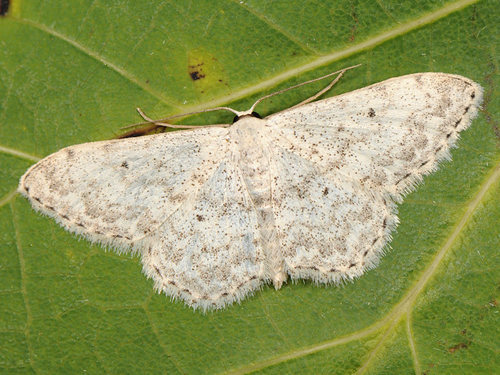
Scopula marginepunctata (Göze, 1781) has a typical wingspan of 25–28 millimetres (0.98–1.10 in), and forewings measure 12–15 millimetres (0.47–0.59 in) in length. Moths from the second generation are often smaller, with a wingspan of only around 18 mm. This species shows variation in both body color and wing pattern. The base wing color ranges from off-white to light brown, and all wings are heavily dusted with dark scales. Darkened forms are found in the Swiss Canton of Ticino; these were formerly classified as the subspecies insubrica. Wing patterns range from dark grey to dark brown, matching the underlying base wing color. The interior cross line and median bands are usually not well developed. When present, the median band is relatively wide but frequently washed out. The interior cross line is often reduced to a row of dots. The outer cross line is almost always significantly developed, very pronounced, and jagged; the tips of the jagged edges are even darker against the marginal field. The front edge of the wing may be slightly darker than the base wing color. In the marginal field, there are usually four to five tooth-shaped, blurred stains; the two penultimate stains are often characteristically close together. Cross lines can differ slightly in intensity between forewings and hindwings. Marginal stains are usually present. Discal flecks are almost always present on both forewings and hindwings. In North Africa, the subspecies Scopula marginepunctata argillacea replaces the nominate form. It is light brown with a relatively weak wing pattern. The subspecies Scopula marginepunctata terrigena occurs in northern Iran, Central Asia, and Mongolia. It is slightly larger than the nominate form, with a 29 millimetres (1.1 in) wingspan. Its marginal and median fields are wide and pale dark brown. The egg of Scopula marginepunctata is an elongated oval, flattened at the top. It is initially light yellow, and turns blotchy red just before hatching. The outer surface has prominent longitudinal ribs that intersect with weaker cross ribs. The caterpillar is relatively long and slender, tapering slightly toward the front. Segments are clearly constricted. Its color ranges from grey-yellow to grey-brown, with a dark dorsal line that is edged with black dots. The underside is slightly darker, and the spiracles are black. The pupa is light brown, with slightly greenish wing sheaths. The head and posterior end are slightly darker. The segments are relatively deep, and the cremaster is relatively short and covered in bristles. Scopula marginepunctata is distributed across Europe, ranging from the Iberian Peninsula in the west to the Ural mountains in the east. To the north, its range reaches the south coast of England, southern Netherlands, and the German Baltic Sea coast, though the species is absent from parts of northern Germany. Isolated populations occur on Bornholm, Skåne, and the southern Baltic. To the south, its range extends across North Africa from Morocco in the west to Egypt. From there, the distribution continues further across the Middle East, Asia Minor, the Caucasus, northern Iran, Central Asia, and Mongolia.