About Scopula imitaria (Hübner, 1799)
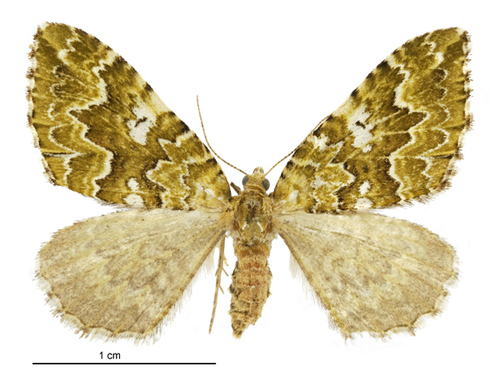
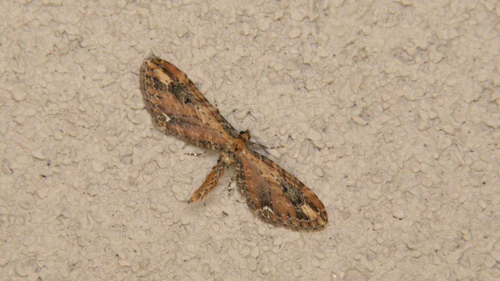
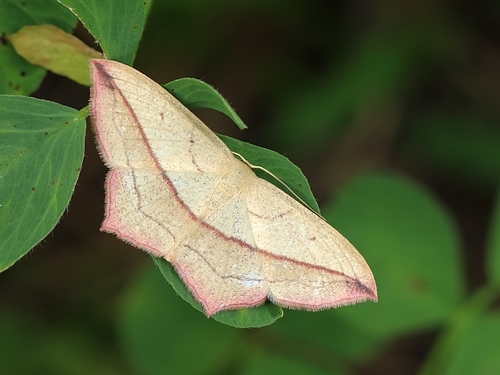
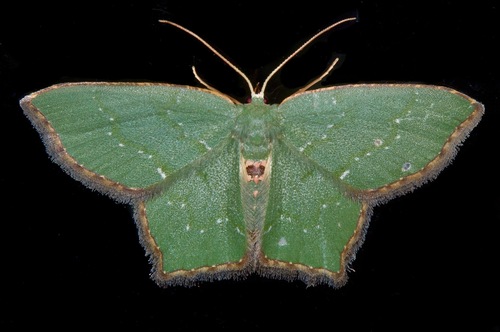
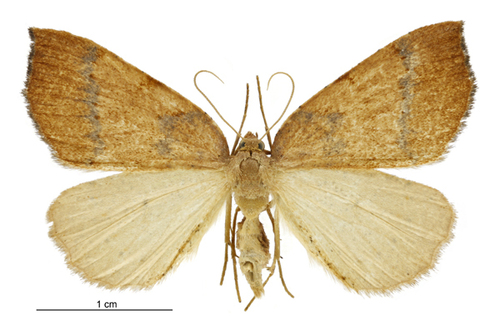
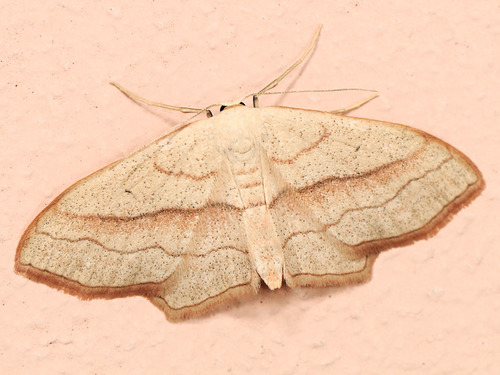
This species is Scopula imitaria (Hübner, 1799). For the first generation, the wingspan measures 12–26 mm; the subsequent generation is typically much smaller, with a maximum wingspan of no more than 18 mm. The leading edge (costa) of the forewing forms an acute angle with the outer edge, creating a sharp point. The hindwings also end in a sharp angle at the middle of their outer edge, forming a "tail". Wing pattern and colouring are variable. Wing colour ranges from reddish, yellowish, or orange to light brown. The standard lines and marginal line are almost always clear, though fine. The median crossline is clearly developed, and slopes slightly diagonally relative to the inner and outer crosslines. It is slightly curved, very weakly wavy, and often accompanied by a shadow facing distally. The inner and outer crosslines are slightly wavy, more distinctly so than the median line. Hindwings share the same general wing pattern, but they often lack the inner crossline. The outer cross line has a pointed bulge directed outwards, which follows the perimeter "tail". Discal flecks are only sometimes present, or weak when they do appear; they are more pronounced on the hindwing. The discal fleck of the hindwing sits on the outside of the median line or in its shadow. On the forewing, this fleck is basal to the median line. The egg is elongate-ovate, strongly flattened at its broader end, with prominent longitudinal ribbing. Its colour is whitish yellow, which becomes orange as it matures, matching the pattern seen in related species. The larva is extremely long and slender, with transversely and very irregularly wrinkled skin. The head is small and rounded. The body is pale ochreous with a distinct brown dorsal line, which is often partially broken into spots in the anterior section, becoming darker and more continuous towards the posterior; the ventral surface is mixed with fuscous. The spiracles are black. Varietal forms exist with a more grey ground colour, or a stronger greenish or red-brown tint, but all forms remain some pale shade. The pupa is golden brown, with ochreous yellow wing-cases. Most of the species' distribution lies in southern Europe (from Portugal to the Balkan peninsula and Greece) and North Africa (from Morocco to Libya). Its range extends east to Asia Minor and Syria. It also occurs across almost all of France, and is present in southern British Isles and Denmark. Specimens have also been recorded in southern Germany, and there are small, isolated populations in western Ukraine. To date, there is no secure evidence of an indigenous population in Germany. In the Middle East, southern Turkey, Cyprus, Crete, and the south-eastern Greek islands, the nominate subspecies S. i. imitaria is replaced by S. i. syriaca Culot, 1918. This subspecies has a less distinctly corrugated outer cross line and a less clearly pronounced marginal line. Its colour is slightly reddish. The reddish yellow form S. i. syriaca occurs especially in hot, dry areas of lowlands and hills. The species is widespread across the Mediterranean region on sandy or stony soil, in maquis shrubland, evergreen oak forests, olive groves, and rocky grassland. In the Alps, S. i. imitaria occurs up to an elevation of 900 m. In Morocco and across the Mediterranean region, it occurs up to 1,400 m above sea level. S. i. imitaria is restricted to coastal areas in western France and southern England. In western Europe, the moth flies in two generations from June to September. The larvae feed on various types of privet.