About Scoparia ambigualis Treitschke, 1829
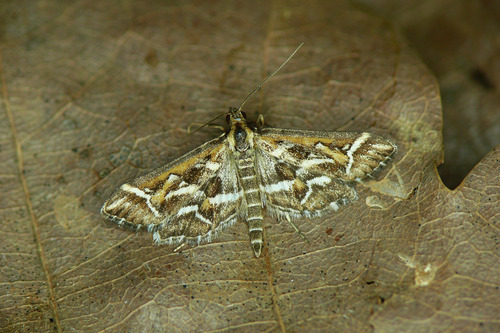
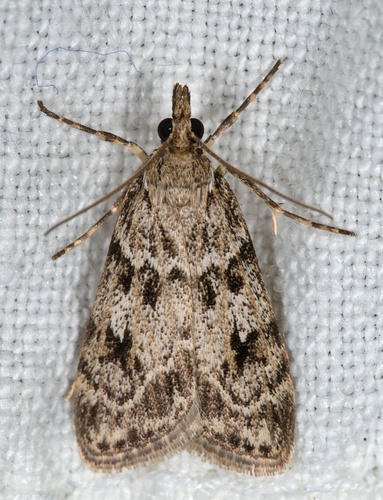
Scoparia ambigualis is a species of moth in the family Crambidae, originally described by Friedrich Treitschke in 1829. This moth is found in Europe, Asia Minor, and possibly occurs in Guangdong and Shanxi, China. It has a wingspan of 15 to 22 millimeters. Its forewings are whitish, and are more or less sprinkled with grey and black. A black mark mixed with ochreous extends from the base of the costa. The forewing lines are whitish with dark edges: the first line is irregular, while the second is angulated above the middle. The orbicular marking is elongate, brownish, more or less black-edged, and rests on the first line. The claviform marking is dot-like and black, and is only rarely elongated to touch the first line. The discal spot is shaped like an 8, has incomplete black edging, and its upper half, and sometimes its lower half, is pale greyish-ochreous or brownish. The terminal area of the forewing is dark; the subterminal line is cloudy and whitish, and there is a terminal series of blackish marks. The hindwings are prismatic grey-whitish, and are suffused with grey toward the terminal edge. Depending on location, adult moths fly from May to September. The larvae feed on valerian, and likely also feed on a variety of mosses.