About Scolitantides orion (Pallas, 1771)
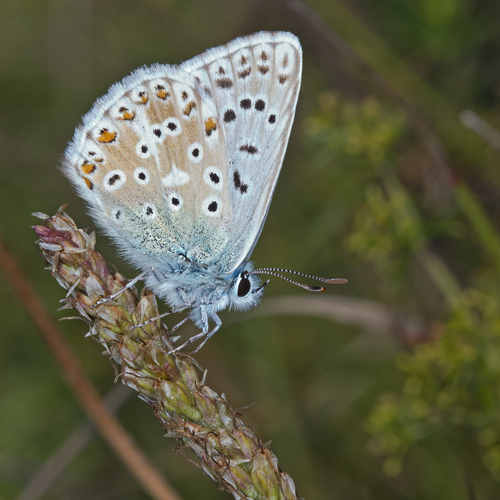
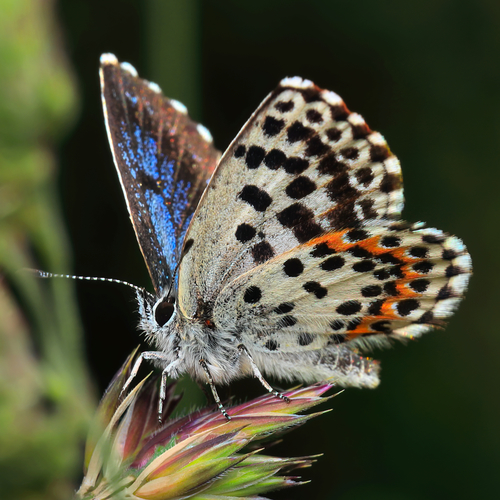
This species, Scolitantides orion (Pallas, 1771), is similar above and below to Pseudophilotes baton, but it is larger and darker. It can be recognized by very distinctly spotted fringes, and its white underside is abundantly and heavily marked with black spots; the underside of the hindwing bears a bright orange-red submarginal band. It is distributed across Europe, and western and northern Asia, excluding England, Arctic countries, and Japan. Its range extends from Finland to the Mediterranean islands, and from the Atlantic Ocean to the Pacific Ocean. The aberration nigra Gerh. occurs alongside typical specimens everywhere, and is the dominant form in some regions, such as Valais. It differs from the typical form in having a uniformly dark upperside, on which only the discocellular spot is visible. The aberration ornata Stgr. has very blue uppersides; such individuals are found singly in Europe, and occur as a regular spring form in eastern Asia. The variant orithyia Gr.-Grsh., collected from the Sinin Mountains in northern Tibet, forms a transition between the typical form and ornata. The light blue marginal rings that are characteristic of ornata are entirely or nearly absent in orithyia. The egg of Scolitantides orion is flattened and white. The larva is light green with a black head and black spiracles. Its first body ring, a lateral stripe, a dorsal line, and a row of spots on each side of the dorsal line are carmine. Larvae feed on Sedum species in autumn, and again in June in southern regions, and are often guarded by ants. The pupa is dirty yellow, with greenish wing-cases. It is fastened either on the ground or above ground on plants, and sometimes multiple pupae are found grouped together. Adult butterflies emerge in early spring (according to Tumma, they can emerge as early as February when kept in a warm room), and emerge again in August in southern regions. The species is very localized, absent from large areas, but is generally not rare where it occurs, particularly on chalk in stony locations. In China, Korea, and Amurland, the species is much more widely distributed than it is in Europe, but it is always restricted to rocky habitats where its food plant grows.