About Scleroderma verrucosum (Bull.) Pers.
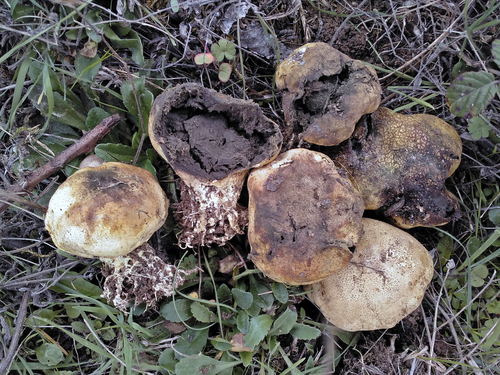
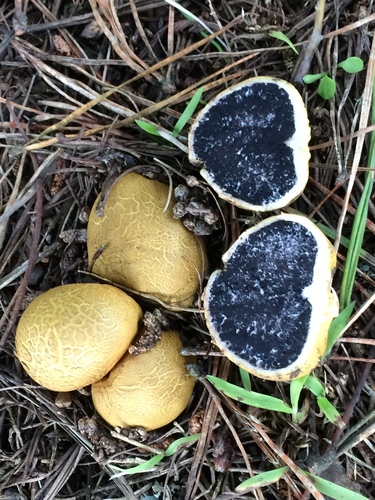
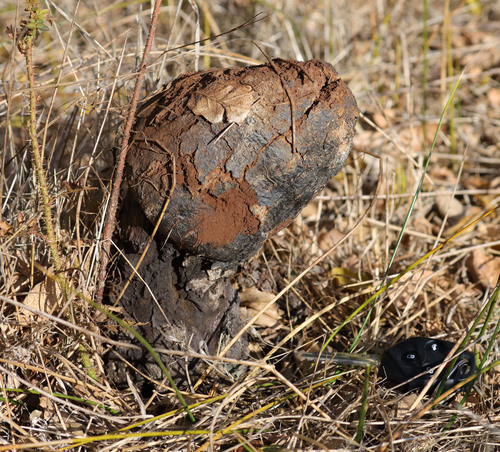
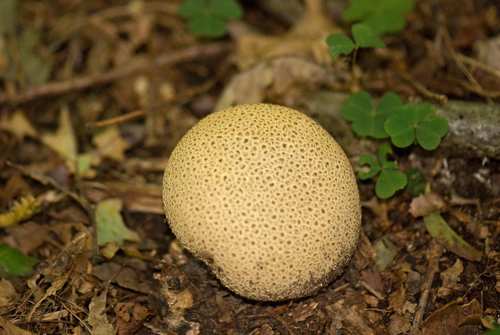
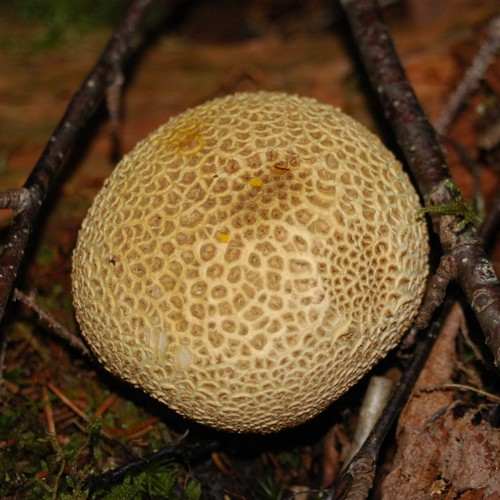
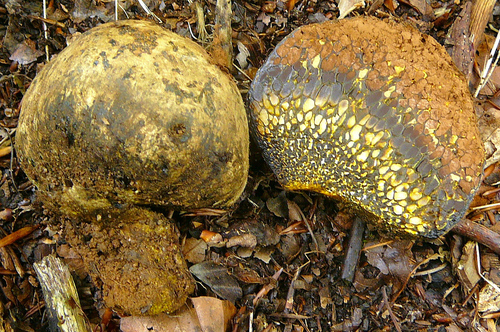
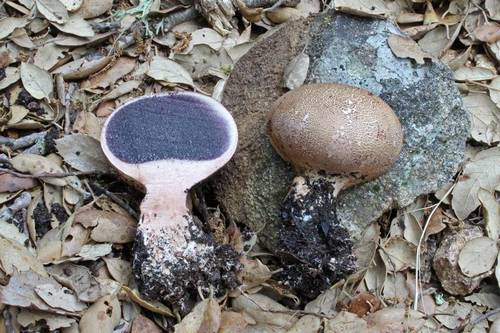
The fruit body of Scleroderma verrucosum is roughly spherical with a somewhat flattened top and a thick, stem-like base, reaching a diameter of 2–7 cm (3⁄4–2+3⁄4 in). It is ochre or dingy brown in color, and its surface is covered with scaly warts that eventually slough off to leave a relatively smooth surface. The thin flesh located underneath the outer skin (called the peridium) stains pink to red when the fruit body is cut open. The peridium is thin and fragile when dry, and cracks irregularly to form a large opening. The internal spore-bearing tissue, known as the gleba, is initially white, but turns light brown and powdery after spores mature. The spores are spherical, covered with minute warts or spines, and measure about 12 μm in diameter. Fruit bodies are edible when the gleba is still firm and white. However, S. verrucosum appears to cause poisoning symptoms similar to Scleroderma citrinum in at least some people, so it cannot be recommended for consumption. All Scleroderma species are ectomycorrhizal. The fruit bodies of Scleroderma verrucosum grow in nutrient-rich sandy soil, often in deciduous forests. This species has been found in Africa, Asia (China and India), Australia, Europe, North America (including Hawaii), and South America. It was featured on a Paraguayan postage stamp in 1985.