About Scleroderma cepa Pers.
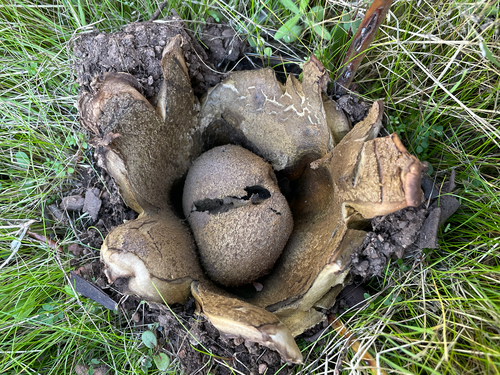
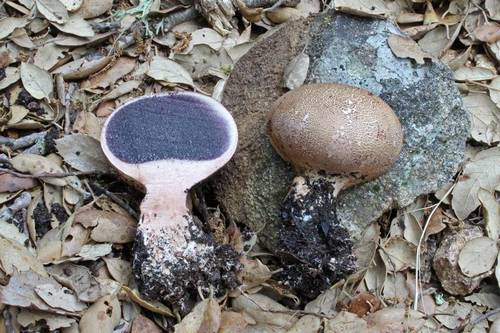
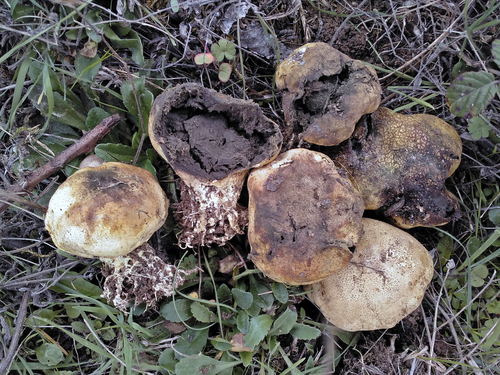
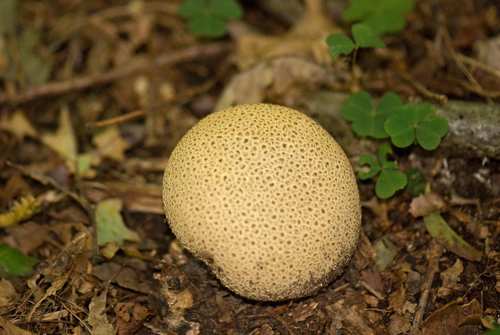
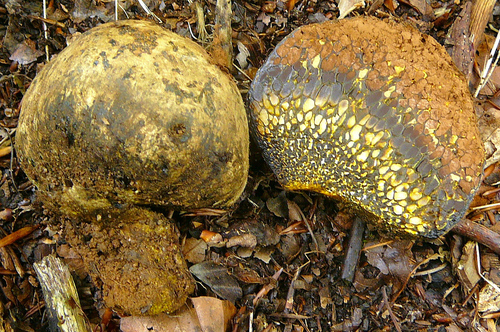
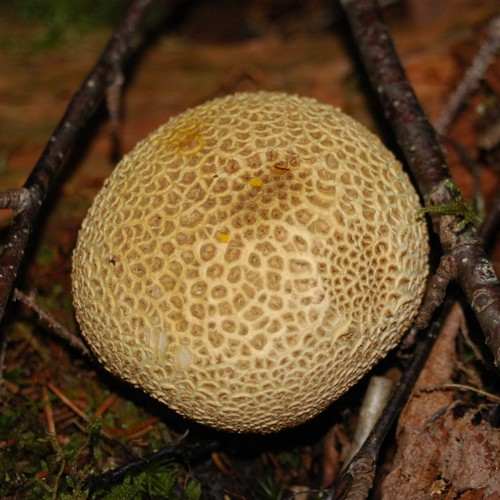
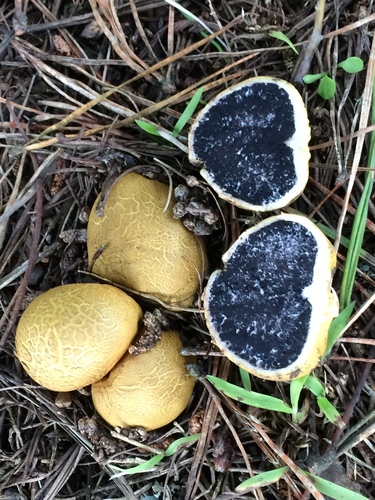
Scleroderma cepa Pers. produces gasteroid fruiting bodies, where spores form and mature inside the fruiting body. Each fruiting body holds a spore-bearing tissue called the gleba, which is enclosed by a protective outer layer called the peridium. Fruiting bodies may grow fully buried in the ground, partially exposed, or fully above ground (epigeous). They are typically rounded or irregularly lobed, often flattened, and measure 1.5 to 6 centimetres (1⁄2 to 2+1⁄4 in) across. The base of the fruiting body is sometimes pinched or folded. S. cepa anchors to the ground via a clump of mycelium; it does not have a true stipe (stem), but the mycelial clump may occasionally clump together to form a false stem called a pseudostipe. The peridium is tough, with a maximum thickness of 1.5 mm. Its surface is dry, and may be smooth or covered in tiny scales. As the fruiting body ages, the peridium develops fine cracks or an areolate (cracked, patch-like) texture, most noticeably on the upper surface. Young S. cepa fruiting bodies are white, and fade to pale brown or yellowish brown as they mature. Bruising from rubbing or handling turns the affected tissue vinaceous or a darker brown. When fully mature, the peridium splits open to release the spores. Young gleba is firm and white; it stays firm as it ages, turning purple-black with scattered white mycelia, and becomes powdery and dull brown at full maturity. In terms of habitat and distribution, S. cepa may grow alone, in scattered groupings, or in clustered groups. It can be found growing in sparse grass, woodlands, landscaped areas, and on disturbed ground. It fruits during summer and fall, in watered areas or after rainfall. This species is ectomycorrhizal. It has a worldwide distribution, and is particularly common in North America, Europe, and Australia. It grows across the entire United States, but is more abundant in the eastern part of the country. S. cepa is poisonous, and causes gastrointestinal upset if consumed. It is used as a soil inoculant in agriculture and horticulture.