About Sclerocarpus uniserialis (Hook.) Benth. & Hook.fil. ex Hemsl.
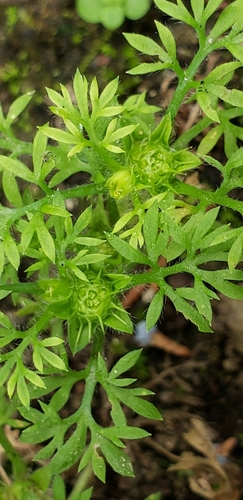
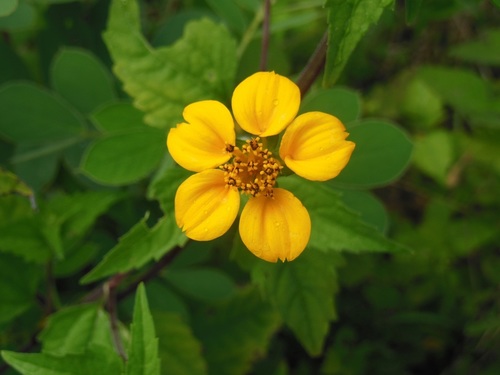
Sclerocarpus uniserialis (Hook.) Benth. & Hook.fil. ex Hemsl. is a species in the daisy family, Asteraceae. The most prominent feature that separates all Sclerocarpus species from roughly 32,000 other Asteraceae species is a structure within their flowering heads. On the flat, floor-like receptacle of the flowering head, scale-like bracts called paleae grow between the bases of individual florets. As these paleae mature, they thicken and harden, and completely enclose their adjacent one-seeded cypsela-type fruits, forming structures called sclerocarps. In a dissected immature flower head of this species, the still-expanding paleae are somewhat spoon-shaped, mostly green with burgundy coloring at their tips; in the center of the dissected head, one palea has been removed to reveal the smooth cypsela inside. Sclerocarpus uniserialis has additional identifying features. Most often it grows as an erect herbaceous annual, though it rarely grows as a leaning or prostrate plant instead, and it may sometimes also be a perennial or sub-woody plant. It can reach up to 2 meters (6 and 1/2 feet) in height. Its leaves are broadest near their base, and have toothed margins. Below the flowering head, up to 9 leaf-like involucral bracts are arranged roughly in a single series; these bracts measure up to 13 mm by 1.5 mm (1/2 inch by 1/16 inch). The petal-like ray florets that line the edge of each flowering head develop 2 or 3 short, clustered teeth at their tips. All mature sclerocarp fruits of this species are tipped with a prominent beak-like projection. A pappus forms a low crown at the top of each fruit; the top margin of this crown may be deeply cut, uncut, or very rarely the crowns may be absent entirely. This species is distributed from Texas in the United States, south through Mexico into Belize and Guatemala. Citizen science observation data from iNaturalist shows that the species is absent from northwestern Mexico, including Baja California. It is also called Mexican Bonebract. In the United States, Mexican Bonebract grows in disturbed sites, and on caliche, limestone, and sandy soils, at elevations up to 300 meters (roughly 1000 feet). In Mexico, it occurs in oak forests, pine forests, mixed oak-pine forests, humid mountain forests, tropical deciduous forests, chaparral, dry scrub, palm groves, and disturbed areas, at elevations up to 2450 meters (roughly 8000 feet). Sclerocarpus uniserialis has been recorded as a weed in cultivated fields of tomato, corn, mango, okra, and luffa. A study of Mexican agroecosystems found that among all recorded weeds, this species had the highest density per hectare in corn agroecosystems, reaching 8,040,000 plants per hectare (equivalent to roughly 3,250,000 plants per acre). Among the Huastec Téenek people of Mexico, infusions made from branches of Sclerocarpus uniserialis are documented to be used to treat diarrhea. This plant is also documented to be fed to horses as food.