About Scleranthus annuus L.
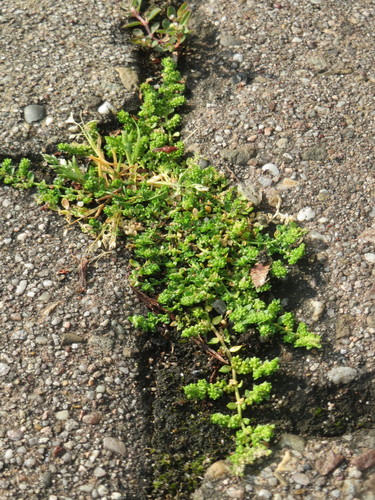
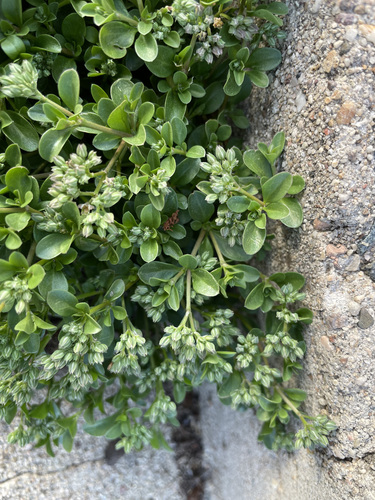
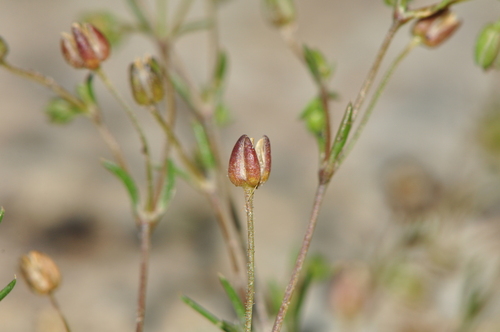
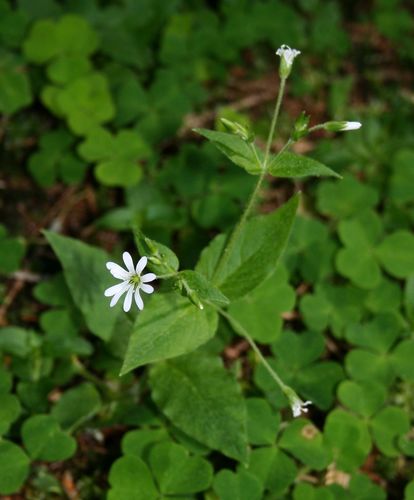
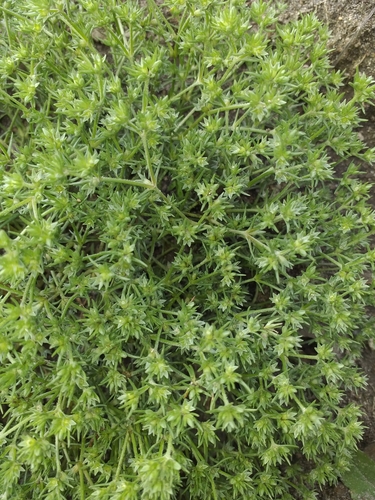
Scleranthus annuus L. is an annual or biennial herb that grows from a taproot. It produces low, heavily branched spreading stems that can reach up to 15 centimeters (6 inches) in length. Its leaves are either needle-like or linear in shape, with sharp, stiff points. The leaves are arranged oppositely in pairs along the stem, and are fused together at their bases. Flowers grow in pairs or small clusters that hold up to five flowers each. The flowers do not have petals, but they do have bell-shaped calyces made of green sepals that resemble petals. This plant grows in soil pockets between rocks, on bare ground, on disturbed sandy soil in heaths, in arable fields, in sand pits, and in quarries. It also occasionally grows on shingle on the coast or alongside rivers. Scleranthus annuus has three distinct life strategies. Some of its seeds germinate in autumn, and the plant overwinters as a small seedling. Other seeds overwinter and germinate in spring, producing flowers the same year. The third group of seeds germinates in spring but do not produce flowers until the following year. For all three groups, the flowering period runs from late May to late August. Because the flowers do not have showy petals and produce very little nectar, they do little to attract insect pollinators, and most flowers are self-pollinated.