About Scirpus cyperinus (L.) Kunth
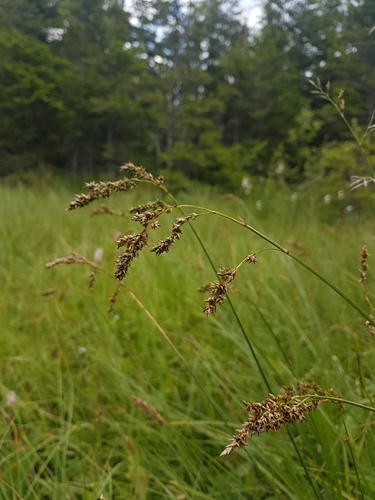
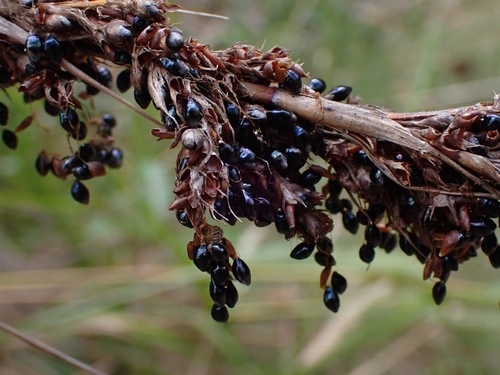
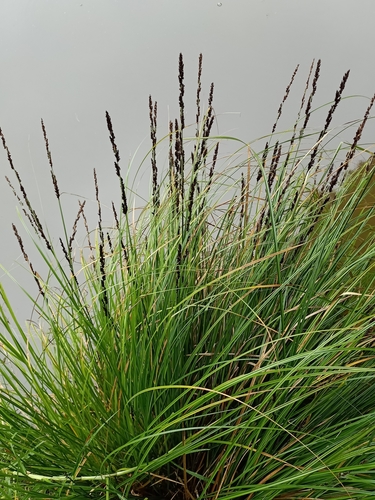
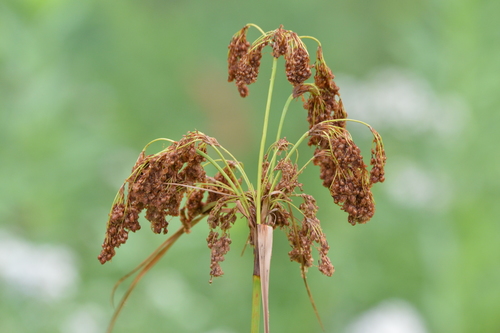
Scirpus cyperinus (L.) Kunth, commonly called woolgrass, is an emergent wetland herb native to eastern United States and eastern Canada. Its other common names are cottongrass bulrush and brown woolly sedge. Despite its common name, woolgrass is not a true grass; it is a species of bulrush in the genus Scirpus. Bulrushes themselves are not true rushes, and instead belong to the sedge group. This sedge species has highly variable appearance, but follows a general growth form: it produces short, tough rhizomes and grows in dense clumps, with upright fertile stems. Each stem bears 5 to 10 leaves, which can reach 80 centimeters long and 1 centimeter wide. The lowest (proximal) leaves have green or reddish sheaths. Its inflorescence has upright or spreading branches that hold cymes, each containing up to 15 spikelets. Individual spikelets are cylindrical or oval, growing up to 0.8 centimeters long, and are covered in reddish, brownish, or black scales. Each flower produces six long bristles, which give the entire inflorescence a woolly appearance. This plant grows in many types of wet habitats, including marshes and ponds, and can also grow in disturbed areas such as ditches. It frequently hybridizes with closely related species Scirpus atrocinctus and Scirpus pedicellatus. Native American groups used this plant for various purposes: the Ojibwa people used it to make bags and mats, while the Potawatomi people used it as stuffing for pillows.