About Scincella lateralis (Say, 1822)
Common Names and Regional Size Ranking
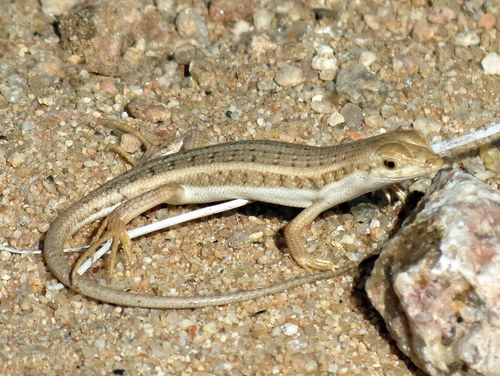
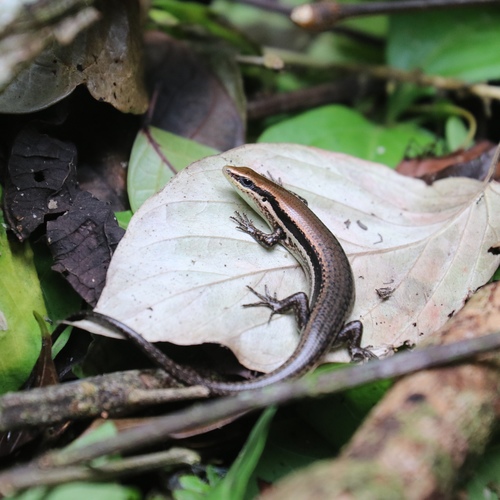
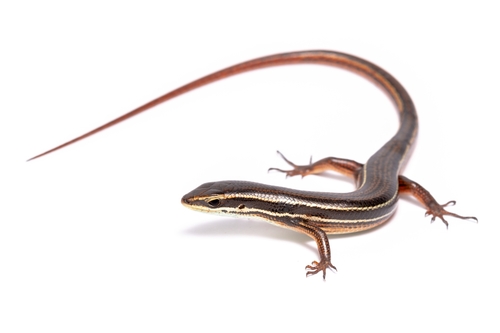
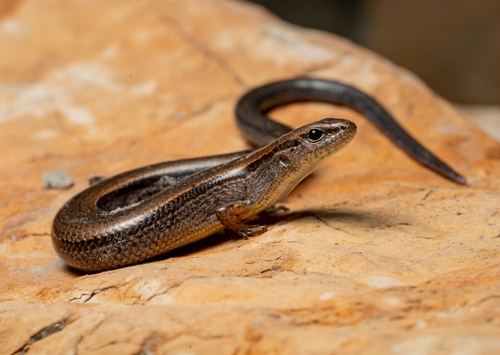
This species, commonly known as the little brown skink or ground skink, is one of the smallest reptiles in North America.
Size and Mass Measurements
Its total length including the tail ranges from 3 to 5.5 inches (7.5 to 14.5 cm), and individuals have a body mass of 1 to 2 grams.
Coloration Pattern
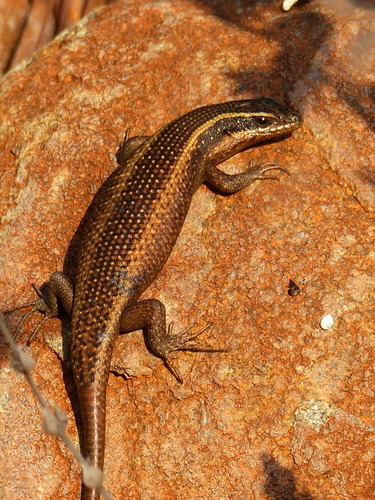
Its back is typically coppery brown, with a white or yellow underside and dark coloration running laterally from the eyes to the tail.
Body and Limb Structure
Like most skinks, it has an elongated body and short legs.
Eyelid Adaptation
Transparent disks in its lower eyelids allow it to see even when its eyes are closed.
Female Growth Trait
Females of this species tend to grow faster and reach a larger size than males.
Dental Correlation
Tooth size and count in this species correlates more strongly with snout-vent length than with head size.
Sexual Dimorphism Traits
Scincella lateralis displays sexual dimorphism: females are generally larger overall, while males have larger heads.
Sexual Dimorphism Origin Hypothesis
It is suggested that this trait may arise from sexual selection that favors larger heads in males during male-male contests.
Male Secondary Coloration
Males may also develop more orange coloration on their heads.
Broad Geographic Range
The ground skink occurs across most of the Eastern United States, ranging south from New Jersey, Ohio, and Kansas to Texas and Florida, and extends into northern Mexico.
Coastal and Regional Abundance
It is found along the Atlantic coast, and is one of the most abundant skink species in southeastern America.
Range Expansions and Isolated Populations
In recent times, it has been sighted in southern New York State, and also occurs in isolated areas such as central Illinois.
Elevation Distribution Limit
It is not found at higher elevations in the Appalachian Mountains.
Geographic Variation Status
It is one of the most abundant and widely distributed members of the skink family, and despite its large geographic range, there is very little geographic variation within the species.
Habitat Types
S. lateralis occupies a wide range of habitats, including deciduous or mixed deciduous-coniferous forests, hedgerows, palmetto hammocks, and the edges of streams and ponds.
Substrate and Shelter Requirements
It requires a deep substrate such as leaf litter, and is known to occasionally shelter in Sabal palmettos.
Historical Population Isolation Drivers
Genetic studies show that several discontinuities in this species' genetic distribution align with major southeastern rivers, indicating that rivers have historically isolated ground skink populations.
Cross-River Gene Flow Evidence
However, phylogeographic evidence confirms that some gene flow occurs across these rivers, including across the Mississippi River.
Dispersal Mechanism for Gene Flow
Meander cutoff may allow passive dispersal across river barriers, which in turn promotes this gene flow.
Clutch Size Parameters
Sexually mature S. lateralis females lay small clutches of 1 to 6 eggs, most often 2 to 3 eggs.
Oviposition Sites
They lay clutches in moist soil, rotting logs, fallen logs, or under rocks.
Egg Laying Timing
Egg laying takes place during the summer; in the Southern United States, this occurs from March through August.
Annual Clutch Frequency
A single female may produce more than one clutch per year.
Parental Care Trait
Unlike females of Eumeces skink species, female ground skinks do not guard their eggs.
Incubation Period
Eggs hatch after one to two months.
Sexual Maturity Timeline
Hatchlings reach sexual maturity at one year of age, and females generally become sexually mature earlier than males.