About Scilla verna Huds.
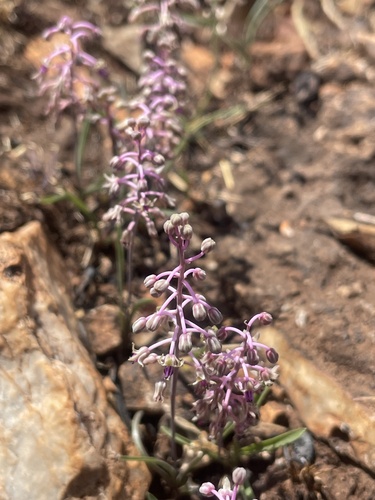
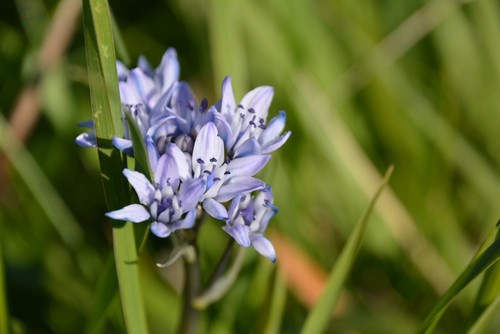
Scilla verna Huds. is a small perennial bulbous plant, typically growing 5–15 centimetres tall. Its ovoid bulb measures 10–15 millimetres across. Two to seven long, narrow leaves grow from the plant's base, reaching 3–20 cm long and 2–5 mm wide. Scentless flowers form a dense cluster of 2 to 12 at the top of an upright stem; each flower has six violet-blue tepals that are 5–8 mm long, and a 5–15 mm long bluish bract at its base. The seeds of this species are ovoid and black, and its diploid chromosome count is 20 or 22. This plant occurs from Morocco northward through Portugal, Spain, France, Great Britain (especially along the west coast), and Ireland (mainly along the east coast), with its range extending as far north as the Faroe Islands and Norway. It grows in short dry grassy areas, most often near the sea, though it can be found at 415 metres above sea level on Foula. It is a key component of the H7 plant community in the British National Vegetation Classification system. In 2002, it was selected as the county flower of County Down in Northern Ireland following a public vote organized by the conservation charity Plantlife. In ecological interactions, the smut fungus Antherospora tractemae infects the flowers of Scilla verna Huds. This fungus is named after Tractema verna, a synonym of this host plant. Phylogenetic study of this smut fungus supports an alternative taxonomic classification that places the host plant in the genus Tractema. Two species of rust fungus, Uromyces scillinus and Uromyces scillarum, infect the leaves of this plant.