About Scilla siberica Andrews
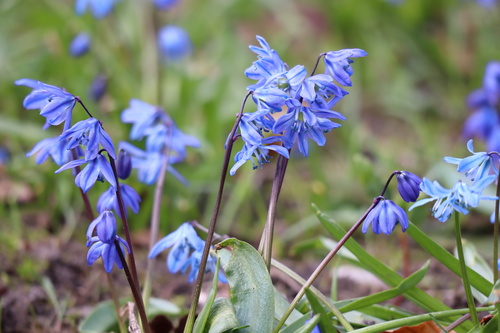
Scilla siberica Andrews is a bulbous perennial that grows 10–20 cm (4–8 in) tall and 5 cm (2 in) wide. It produces two to four strap-shaped leaves in early spring, at the same time as its nodding, blue, bell-shaped flowers. Flowers have six tepals and six stamens, and are borne either singly or in racemes of two or three. In bright sunlight, the tepals may reflex to a horizontal position, but the flowers are more often cup-shaped. While flowers are usually blue, the variety Scilla siberica var. alba has white flowers. Unlike the related genus Puschkinia, where stamens are fused into a tube, the stamens of Scilla are separate, and the pollen of this species is dark blue. After flowering, the flower stems go limp as the seed capsules (pods) mature. When fully mature, the purple capsules split open to release small, dark brown seeds. Once seeds are mature, the leaves wither, and the plant enters dormancy until the following spring. Seedlings of this species have hollow leaves. Scilla siberica is cultivated for its bluebell-like flowers. It naturalizes quickly from seed. Growing to around 15 cm (5.9 in), it is well-suited for planting in grass, and spreads via seed to form large colonies that become dormant before grass needs to be mowed. In the Midwestern United States, it is becoming invasive in some locations. This plant has received the Royal Horticultural Society's Award of Garden Merit.