About Scilla sardensis (Whittall ex Barr & Sugden) Speta
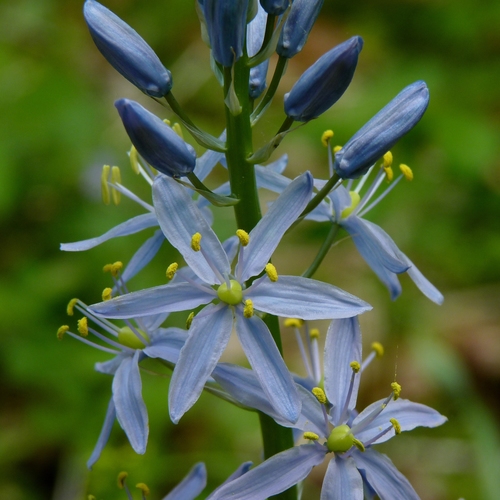
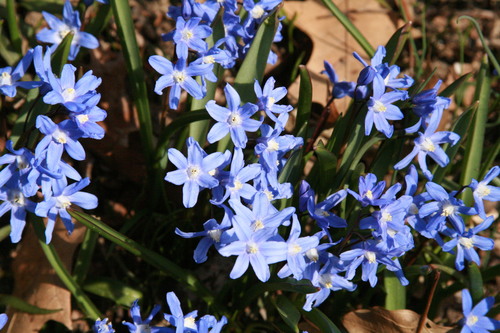
Like all species previously placed in the former genus Chionodoxa, the bases of the stamens of Scilla sardensis are flattened and closely clustered in the center of the flower. This differs from other Scilla species, whose stamens are not flattened and do not cluster together. Scilla sardensis resembles Scilla forbesii, but has a less distinct white 'eye' at the center of its flower. Each bulb produces two to three leaves, which grow up to 13.6 cm long and 1.5 cm wide. Each bulb produces at most one flowering stem, which reaches up to 14 cm in length. Flowers are borne in a loose pyramidal to one-sided raceme, with up to 22 flowers per stem. Each individual flower grows up to 2.5 cm across, with each tepal measuring 1.5 cm long. The tepals are violet-blue, and are somewhat paler at the base, creating a paler 'eye' at the center of the flower. The bases of the stamens are white. Scilla sardensis is native to western Turkey, where it has a restricted distribution in the Bozdağ Mountains of İzmir Province. This plant has received the Royal Horticultural Society's Award of Garden Merit, with confirmation of this award in 2017.