About Scilla luciliae (Boiss.) Speta
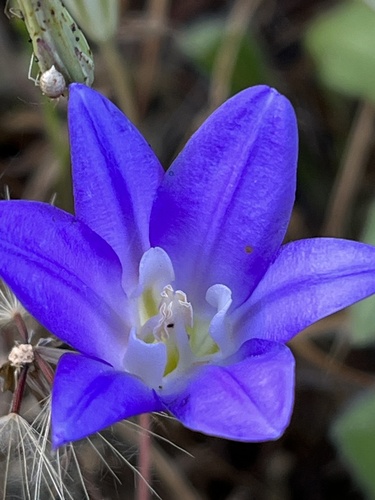
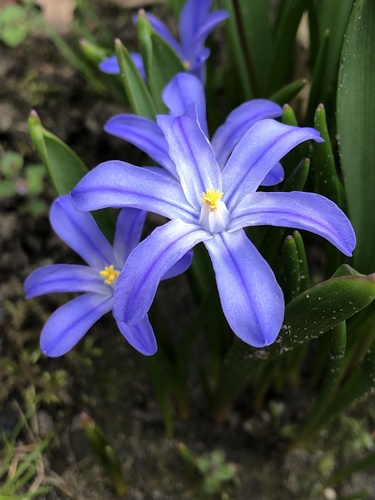
Scilla luciliae (Boiss.) Speta is a low-maintenance plant that naturalizes readily, growing in USDA plant hardiness zones 3 through 8. Its flowers have a white center, with petals ranging from lilac blue to violet blue. Like all species formerly placed in the genus Chionodoxa, the bases of its stamens are flattened and closely clustered in the center of the flower. This distinguishes it from other Scilla species, whose stamens are not flattened or clustered. Each bulb produces two leaves, which grow up to 8 cm long and 2 cm wide, and at most one flowering stem, which grows up to 10 cm long. Flowers are borne in a loose pyramidal raceme, with 2 to 3 upward-facing flowers per stem. Each flower can reach up to 3.5 cm across. The base of each tepal is white, as are the stamen filaments, creating a white 'eye' at the center of the flower; the outer portion of the tepals is violet-blue. This species can be told apart from S. forbesii, the most common species grown in gardens, by its much lower number of slightly larger flowers per stem. According to the Missouri Botanical Garden, it is a spring ephemeral, meaning it dies back and disappears after blooming, remaining dormant until the following spring. Scilla luciliae is native to western Turkey, where it has a restricted distribution limited to Mahmut Mountain in İzmir Province. The non-profit biodiversity database NatureServe Explorer notes that it has naturalized in North America, where it was previously referred to by the scientific name Chionodoxa luciliae, and carries the common names Lucile's Squill in English and Scille gloire-des-neiges in French. Many frost-hardy plants in the genera Scilla, Chionodoxa, Hyacinthoides, Muscari, Puschkinia, Brimeura, Hyacinthella, Bellevalia, Hyacinthus, and Ornithogalum have been awarded the Royal Horticultural Society's Award of Garden Merit. To earn this award, plants must demonstrate decorative excellence, be readily available to purchase, be hardy, not require specialist growing conditions, be resistant to pests and disease, and not be prone to reverting to a less cultivated form. Under its former name Chionodoxa luciliae, this plant had its Award of Garden Merit reconfirmed in 1993, with trial plants sourced from the United Kingdom, Denmark, and the Netherlands. Scilla luciliae had its Award of Garden Merit confirmed again in 2017.