About Scilla forbesii (Baker) Speta
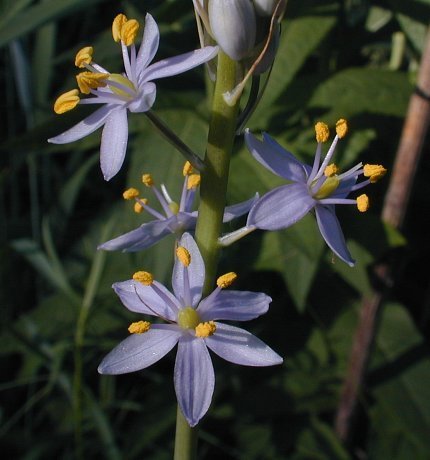
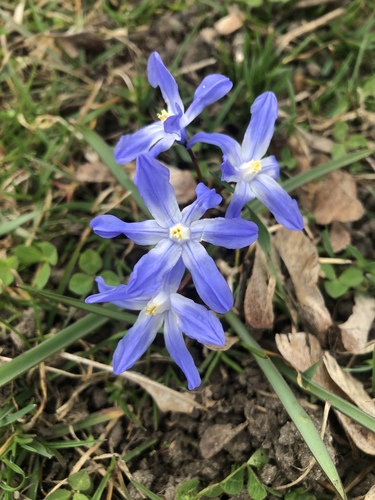
Like all species that were formerly placed in the genus Chionodoxa, Scilla forbesii has flattened stamen bases that are closely clustered in the center of the flower. In other Scilla species, stamens are not flattened or clustered together. Each bulb of Scilla forbesii produces two leaves, which grow up to 12 cm long and 2 cm wide, and at most one flowering stem that reaches up to 10.5 cm in length. Flowers are borne in a broadly pyramidal raceme, with up to 12 flowers per stem. Lower flowers face outwards, while upper flowers face upward. Each flower grows up to 3 cm across, with individual tepals 1.3 cm long. The base of each tepal is white, as are the stamen filaments, forming a distinctive white 'eye' at the center of the flower. The outer portion of each tepal is colored deep blue to violet-blue. For botanists that treat S. siehei as a separate species from S. forbesii, S. forbesii differs in having fewer, smaller upward-facing flowers that are deep blue rather than violet-blue. When Scilla forbesii is treated as including S. siehei, it is native to western and southern Turkey. Yildirim et al., who treat S. forbesii and S. siehei as separate species, assign the two species slightly different ranges within Turkey: S. forbesii is recorded as occurring only on Babadağ Mountain in Muğla Province, while S. siehei is recorded as occurring only on Nif Mountain in İzmir Province. Scilla forbesii is the most common species of this group grown in gardens, and is often incorrectly identified as S. luciliae. It is available for purchase as dry bulbs, often sold under the alternative names Scilla luciliae, Chionodoxa luciliae, Scilla siehei or Chionodoxa siehei. Bulbs are planted when dormant in late summer or early autumn, at a depth of 8–10 cm. Scilla forbesii requires light during its growth period, but can be grown under deciduous trees or shrubs because its foliage dies back after flowering. It flowers in early to mid spring. The common blue form self-seeds freely in many gardens, forming large colonies. When S. siehei was considered a separate species, it was awarded the Royal Horticultural Society (RHS) Award of Garden Merit in 1993, and this award was reconfirmed in 2005. A white-flowered variety alba exists, and the cultivar 'Pink Giant' produces pink flowers with white centers.