About Schoenoplectus tabernaemontani (C.C.Gmel.) Palla
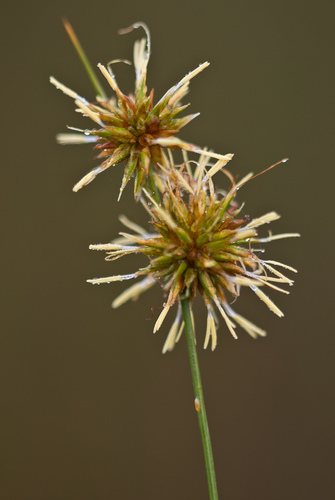
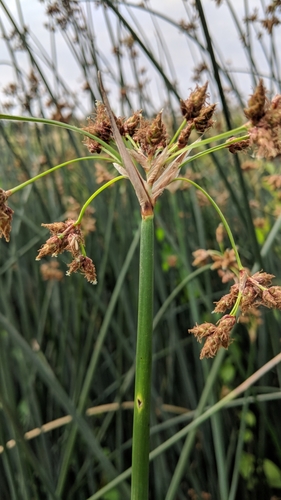
Schoenoplectus tabernaemontani (C.C.Gmel.) Palla is a flowering plant species in the sedge family, commonly called grey club-rush, softstem bulrush, and great bulrush. It has a near-cosmopolitan distribution: it occurs in every European country except Iceland, all of temperate Asia except Mongolia, every U.S. state including Hawaii, every Canadian province and territory except Nunavut, and most of Australasia. It is less widespread across Africa and South America, but is still present in multiple countries on both continents. This species grows in wet habitats, most often in shallow water. It is most abundant in brackish and tidal estuarine water, but also grows widely in fresh water. Schoenoplectus tabernaemontani has quite variable appearance, which accounts for the long list of synonyms that have been assigned to it over time. It is a perennial herb that forms dense stands of many narrow erect stems, which usually reach 1–1.5 m (3–5 ft) in height, and rarely grow as tall as 3 m (10 ft). It grows from an extensive long rhizome system. Most of its leaves are basal, usually located underwater, and have wide sheaths that wrap around the stems. Its inflorescence is a panicle of spikelets borne on thin 2–6 cm long stems that may spread, arch, or droop. The spikelets show variable shades of brown. A long, stiff bract typically grows alongside each individual spikelet or cluster of spikelets. Flowering occurs in early to mid summer, which corresponds to June to July in Britain, and fruiting occurs in late summer to early autumn, corresponding to August to September in Britain. It is closely related to Schoenoplectus lacustris, or common club-rush. It can be distinguished from S. lacustris by its smaller maximum size (up to 1.5 m, compared to 3 m for S. lacustris), its more slender, glaucous stems, and its flowers having only two stigmas instead of three. Like S. lacustris, it has stems that are circular in cross-section, which differs from the triangular stems of Schoenoplectus triqueter, or triangular club-rush. The new shoots and young roots of Schoenoplectus tabernaemontani may be eaten raw or cooked. Older roots can be processed into flour. In Hawaii, where this species is called ‘aka‘akai, kaluhā, or nānaku, its stems are used to make floor mats. In New Zealand, where it is known as kāpūngāwhā, it is used as a source of material for weaving fabric. A striped cultivar, S. tabernaemontani 'Zebrinus', which bears bright horizontal white or yellowish stripes, is sold as an ornamental plant for water gardens and landscaping. Solid white and solid yellow cultivars of this species are also available.