About Schoeniophylax phryganophilus (Vieillot, 1817)
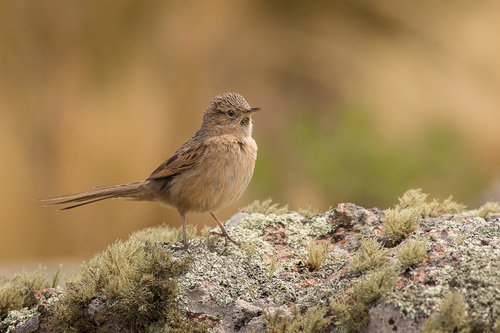
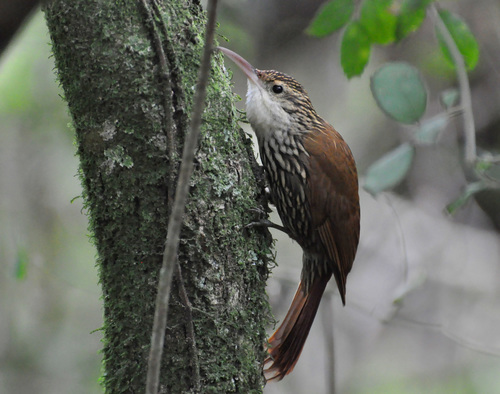
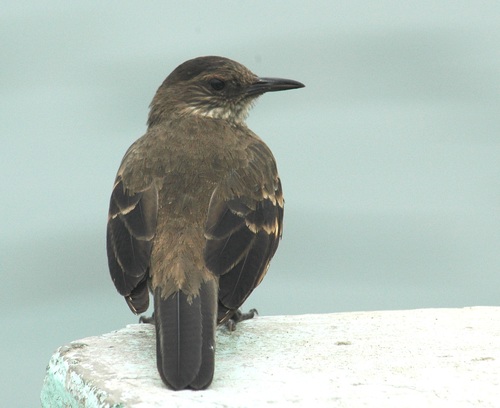
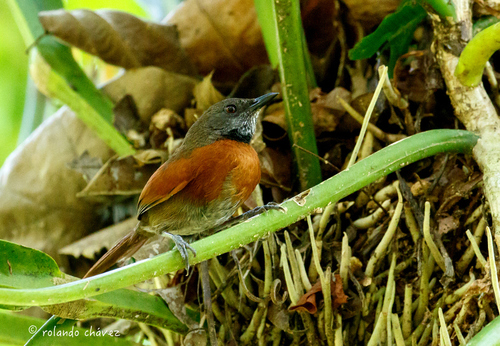
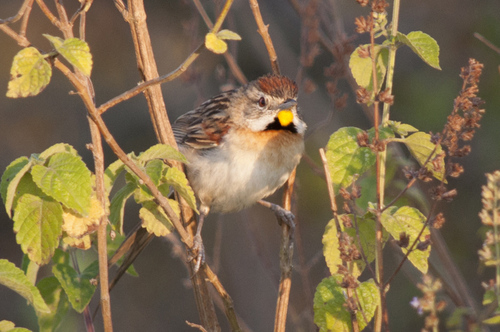
The chotoy spinetail, with the scientific name Schoeniophylax phryganophilus (Vieillot, 1817), measures 20 to 22 cm (7.9 to 8.7 in) in length and weighs 15 to 22.5 g (0.53 to 0.79 oz). It is a large spinetail distinguished by a unique throat pattern, and both sexes have identical plumage. Adults of the nominate subspecies have a white supercilium and light brown ear coverts. Their forehead is dark brown, their crown is chestnut with faint brown streaks, their back is sandy brown with prominent dark brown streaks, and their lower back, rump, and uppertail coverts are light brown. Their wings are mostly light brown with a chestnut shoulder. Their tail is long and light brown with blackish feather shafts. Their chin and upper throat are bright yellow, while their lower throat forms a crisp black square surrounded by white. Their upper breast is apricot-colored, their lower breast is buffy white, their belly is whitish, their flanks are brownish buff, and their undertail coverts are rufescent buff. Their iris ranges from red to brown, their maxilla is blackish to dark gray, their mandible is gray to bluish (sometimes with a dark tip), and their legs and feet are light gray to brownish. Compared to adults, juveniles have less distinct streaking on their upperparts, a brown crown, a whitish chin, and an indistinct black throat patch. The subspecies S. p. petersi has plumage matching that of the nominate subspecies, but it is smaller in size. There are two subspecies of chotoy spinetail, and the nominate subspecies is far more widespread. It occurs in eastern Bolivia, the Brazilian states of Mato Grosso do Sul and Rio Grande do Sul, most of Paraguay, northeastern Argentina extending south to northern Buenos Aires Province, and nearly all of Uruguay. Subspecies S. p. petersi has a disjunct distribution: it is found in the northeastern Brazilian states of Minas Gerais and Bahia, with an additional separate population far away in Piauí. The species lives in a range of open to semi-open landscapes, including treed savanna, gallery forest, thickets, scrub along watercourses, monte woodlands, and marsh edges. It occurs at elevations from near sea level up to 500 m (1,600 ft).