About Schlumbergera truncata (Haw.) Moran
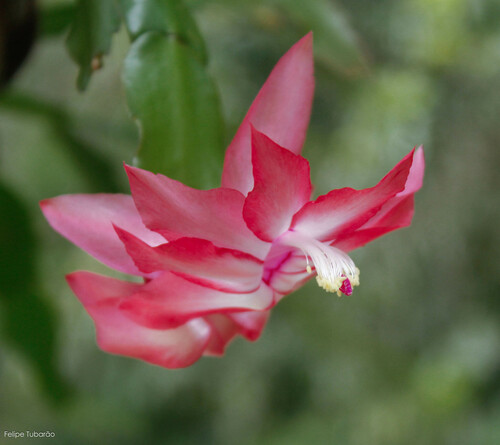
Like other species in the genus Schlumbergera, Schlumbergera truncata has leafless green stems that function as photosynthetic organs. These stems, called cladodes, are made up of strongly flattened segments, which have two or three teeth of varying shapes along their edges and at their ends. The tips of the stems are truncated (cut off) rather than pointed. When fully mature, individual segments measure around 4–6 cm (1.6–2.4 in) long and 1.5–3.5 cm (0.6–1.4 in) wide. Size variation most often depends on the age of the segment, as well as access to sunlight and water. Areoles, the specialized structures unique to cacti, form between two teeth at the end of each segment. These areoles are covered in brown wool and bear bristles up to 3 mm (0.1 in) long; this is where flower buds emerge and new segments grow. The flowers are held at a steady angle slightly above horizontal, and are zygomorphic, meaning bilaterally symmetrical with a distinct upper and lower side. Flowers measure around 6.5–8 cm (2.6–3.1 in) long and 4–6 cm (1.6–2.4 in) across. There are six to eight tepals, which can come in a range of colors including shades of red, orange, pink and white. The outer tepals, located at the base of the flower, are shorter and curved backward, while the inner tepals are longer and fused at the base to form a floral tube; nectar is produced at the base of this tube. The lower inner tepals curve backward, making the upper inner tepals appear longer. S. truncata flowers in the autumn: around May in its natural habitat, and from October to November when cultivated in the Northern Hemisphere. Short days and long nights are required to trigger flowering. These floral traits are important for distinguishing S. truncata from other cactus species, as they influence characteristics such as nectar production and function. A trait shared by all Schlumbergera species is that the numerous stamens are arranged in two series: inner stamens form a ring around the style, while outer stamens grow from the floral tube. The stamen filaments are white, and the anthers and pollen are yellow. The style ends in six to eight lobes and is dark red. Additionally, S. truncata has unique reproductive traits compared to other members of the genus Schlumbergera, including differences in seed development, germination, and fruit production. When ripe, the fruit is red, pear-shaped, and around 1.2 cm (0.5 in) long, though it can reach up to 2.3 cm (0.9 in) long in exceptional cases. The shiny seeds are black, each with a diameter of about 1 mm (0.04 in). Schlumbergera truncata is found only in a small area of the coastal mountains of southeastern Brazil, in the state of Rio de Janeiro, located in the southernmost part of the tropics. Confirmed sites where it has been found include the Organ Mountains (Serra dos Órgãos) within Parque Nacional da Serra dos Órgãos, and the Serra do Mar near the city of Rio de Janeiro. Plants grow at altitudes between 700 and 1,000 metres (2,300–3,300 ft). Due to their altitude and proximity to the Atlantic Ocean, these coastal mountains have high humidity: warm moist air is pushed upward into cooler higher elevations, where it condenses. S. truncata most commonly grows as an epiphyte on trees, or as an epilythic plant on rocks. The native status of S. truncata has become unclear because European cultivars were deliberately introduced into some areas, including Parque Nacional da Serra dos Órgãos, by the Brazilian Agricultural Department to offset over-collecting of wild populations. This climate suits S. truncata because of the species' moisture preferences. Humidity and moisture have a significant impact on pollen viability, which shapes the climate range for outdoor growth of the species. Schlumbergera truncata is most often grown as cultivars of the species, or as hybrids between this species and other Schlumbergera, particularly S. russelliana. General information on these plants and their cultivation is covered under the entry Schlumbergera: Cultivation. There are cultivation differences between S. truncata and other Schlumbergera species largely because S. truncata is the variety that grows outdoors, rather than being the commercially sold houseplant type. Some S. truncata plants are capable of self-fertilization, while most other Schlumbergera species are self-incompatible.